This is a LONG article with NO TL:DR section. Though you may want to scroll to the “Summation” section at the bottom of the article.
The following “Fact” section was taken directly from the links provided after specific sections. I did not include all the text from those links, electing to copy that which I felt was pertinent and reasonably understood by all. Please check out the links for much more information on Lasers.
Discliamer: I am not a scientist, so I may get some things wrong in this article. Now onto the article:
Fact
What is a Laser?
A laser is a device that emits light (electromagnetic radiation) through a process of optical amplification based on the stimulated emission of photons. The term “laser” originated as an acronym for Light Amplification by Stimulated Emission of Radiation. The emitted laser light is notable for its high degree of spatial and temporal coherence, unattainable using other technologies. In modern usage “light” broadly denotes electromagnetic radiation of any frequency, not only visible light, hence infrared laser, ultraviolet laser, X-ray laser, and so on. (Layman’s terms: Light is bounced back and forth at an accelerated speed between mirrors-one being partially transparent, light escaping this can be focus to form a laser.)
Spatial coherence typically is expressed through the output being a narrow beam which is diffraction-limited, often a so-called “pencil beam.” Laser beams can be focused to very tiny spots, achieving a very high irradiance. Or they can be launched into a beam of very low divergence in order to concentrate their power at a large distance.
Temporal (or longitudinal) coherence implies a polarized wave at a single frequency whose phase is correlated over a relatively large distance (the coherence length) along the beam.
Most so-called “single wavelength” lasers actually produce radiation in several modes having slightly different frequencies (wavelengths), often not in a single polarization. And although temporal coherence implies monochromaticity, there are even lasers that emit a broad spectrum of light, or emit different wavelengths of light simultaneously. There are some lasers which are not single spatial mode and consequently their light beams diverge more than required by the diffraction limit. However all such devices are classified as “lasers” based on their method of producing that light: stimulated emission. Lasers are employed in applications where light of the required spatial or temporal coherence could not be produced using simpler technologies.
How is a laser created/designed?
A laser consists of a gain medium, a mechanism to supply energy to it, and something to provide optical feedback. The gain medium is a material with properties that allow it to amplify light by stimulated emission. Light of a specific wavelength that passes through the gain medium is amplified (increases in power).
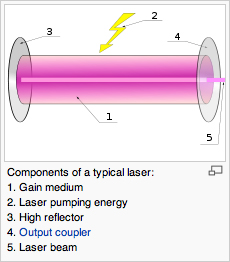
For the gain medium to amplify light, it needs to be supplied with energy. This process is called pumping. The energy is typically supplied as an electrical current, or as light at a different wavelength. Pump light may be provided by a flash lamp or by another laser.
The most common type of laser uses feedback from an optical cavity—a pair of mirrors on either end of the gain medium. Light bounces back and forth between the mirrors, passing through the gain medium and being amplified each time. Typically one of the two mirrors, the output coupler, is partially transparent. Some of the light escapes through this mirror. Depending on the design of the cavity (whether the mirrors are flat or curved), the light coming out of the laser may spread out or form a narrow beam. This type of device is sometimes called a laser oscillator in analogy to electronic oscillators, in which an electronic amplifier receives electrical feedback that causes it to produce a signal.
Most practical lasers contain additional elements that affect properties of the emitted light such as the polarization, the wavelength, and the shape of the beam.
The light emitted:
The beam in the cavity and the output beam of the laser, when travelling in free space (or a homogenous medium) rather than waveguides (as in an optical fiber laser), can be approximated as a Gaussian beam in most lasers; such beams exhibit the minimum divergence for a given diameter. (Think Gauss Hog’s laser).
The differences of a Red or Green laser are as such:
The red laser light has a longer wavelength (about 650 nanometers) than does the green (about 532 nanometers). The mechanism behind making them is also different. Red lasers use a diode, optics, and some electronics. These are fairly easy to make and assemble, so red lasers are cheap. The green laser, on the other hand, requires a special diode (an 808 diode for those who know their lasers), a second infrared laser crystal, and a frequency-doubling crystal. These have to be very carefully aligned in order for the laser to function properly.
For more info on the color of lasers please check out this link: http://www.physlink.com/education/askexperts/ae435.cfm
Pulse mode of operation:
Pulsed operation of lasers refers to any laser not classified as continuous wave, so that the optical power appears in pulses of some duration at some repetition rate. This encompasses a wide range of technologies addressing a number of different motivations. Some lasers are pulsed simply because they cannot be run in continuous mode.
In other cases the application requires the production of pulses having as large an energy as possible. Since the pulse energy is equal to the average power divided by the repetition rate, this goal can sometimes be satisfied by lowering the rate of pulses so that more energy can be built up in between pulses.
Other applications rely on the peak pulse power (rather than the energy in the pulse), especially in order to obtain nonlinear optical effects. For a given pulse energy, this requires creating pulses of the shortest possible duration utilizing techniques such as Q-switching.
In a Q-switched laser, the population inversion is allowed to build up by introducing loss inside the resonator which exceeds the gain of the medium; this can also be described as a reduction of the quality factor or ‘Q’ of the cavity. Then, after the pump energy stored in the laser medium has approached the maximum possible level, the introduced loss mechanism (often an electro- or acousto-optical element) is rapidly removed (or that occurs by itself in a passive device), allowing lasing to begin which rapidly obtains the stored energy in the gain medium. This results in a short pulse incorporating that energy, and thus a high peak power.
Pulsed pumping:
Another method of achieving pulsed laser operation is to pump the laser material with a source that is itself pulsed, either through electronic charging in the case of flash lamps, or another laser which is already pulsed. Pulsed pumping was historically used with dye lasers where the inverted population lifetime of a dye molecule was so short that a high energy, fast pump was needed. The way to overcome this problem was to charge up large capacitors which are then switched to discharge through flashlamps, producing an intense flash.
http://en.wikipedia.org/wiki/Laser
Gas Dynamic Laser:
Gas Dynamic Laser (GDL) is laser based on differences in relaxation velocities of molecular vibrational states. The laser medium gas has such properties that an energetically lower vibrational state relaxes faster than a higher vibrational state, thus a population inversion is achieved in a particular time.
Pure Gas dynamic lasers usually use a combustion chamber, supersonic expansion nozzle and CO2 as an active laser medium in mixture with nitrogen or helium. Gas dynamic laser could be however pumped not only by combustion, but by any adiabatic expansion of gas. Any hot and compressed gas with appropriate vibrational structure could be utilized.
Explosively pumped gas dynamic laser is a version of gas dynamic laser pumped by expansion of explosion products. Hexanitrobenzene and/or tetranitromethane with metal powder is preferred explosive. This device could have very high pulse peak power output applicable in laser weapons.
How a Gas Dynamic Laser Functions:
1. Hot compressed gas is generated.
2. Gas expands through subsonic or supersonic expansion nozzle, the temperature of the gas becomes lower and according to maxwell–Boltzmann distribution the gas isn’t in thermodynamic equilibrium until the vibrational states relax.
3. The gas flows through the tube of a particular length for a particular time. In this time lower vibrational state does relax but higher vibrational state doesn’t. Thus population inversion is achieved.
4. Gas flows through mirror area where stimulated emission takes place.
5. Gas returns to equilibrium and becomes warm. It must be removed from the laser cavity or it will interfere with the thermodynamics and vibrational state relaxation of the freshly expanded gas.
http://en.wikipedia.org/wiki/Gas_dynamic_laser
Operational Advantages of Lasers:
Laser weapons could have several main advantages over conventional weaponry:
- Laser beams travel at the speed of light, so there is no need (except over very long distances) for users to compensate for target movement when firing over long distances. Consequently, evading a laser after it has been fired is impossible.
- Because of the extremely high speed of light it is only slightly affected by gravity, so that long range projection requires little compensation. Other aspects such as wind speed can be neglected at most times, unless shooting through an absorption matter.
- Lasers can change focusing configuration to provide an active area that can be much smaller or larger than projectile weaponry.
- Given a sufficient power source, laser weapons could essentially have limitless ammunition.
- Because light has a practically nil ratio (exactly 1/c) of momentum to energy, lasers produce negligible recoil.
- The operational range of a laser weapon can be much larger than that of a ballistic weapon, depending on atmospheric conditions and power level.
Blooming of a Laser:
Laser beams begin to cause plasma breakdown in the air at energy densities of around a megajoule per cubic centimeter. This effect, called “blooming,” causes the laser to defocus and disperse energy into the atmosphere. Blooming can be more severe if there is fog, smoke, or dust in the air.
Reducing blooming:
- Spread the beam across a large, curved mirror that focuses the power on the target, to keep energy density en route too low for blooming to happen. This requires a large, very precise, fragile mirror, mounted somewhat like a searchlight, requiring bulky machinery to slew the mirror to aim the laser.
- Use a phased array. For typical laser wavelengths this method requires billions of micrometre-size antennae. No way to make these is known. However, carbon nanotubes have been proposed. Phased arrays could theoretically also perform phase-conjugate amplification (see below). Phased arrays do not require mirrors or lenses, can be made flat and thus do not require a turret-like system (as in “spread beam”) to be aimed, though range will suffer at extreme angles (that is, the angle the beam forms to the surface of the phased array).
- Use a phase-conjugate laser system. Here, a “finder” or “guide” laser illuminates the target. Any mirror-like (“specular”) points on the target reflect light that is sensed by the weapon’s primary amplifier. The weapon then amplifies inverted waves in a positive feedback loop, destroying the target with shockwaves as the specular regions evaporate. This avoids blooming because the waves from the target passed through the blooming, and therefore show the most conductive optical path; this automatically corrects for the distortions caused by blooming. Experimental systems using this method usually use special chemicals to form a “phase-conjugate mirror“. In most systems, the mirror overheats dramatically at weapon-useful power levels.
- Use a very short pulse that finishes before blooming interferes.
- Focus multiple lasers of relatively low power on a single target.
High Power Consumption:
One major problem with laser weapons (and directed-energy weapons in general) is their high electric energy requirements. Existing methods of storing, conducting, transforming, and directing energy are inadequate to produce a convenient hand-held weapon. Existing lasers waste much energy as heat, requiring still-bulky cooling equipment to avoid overheating damage. Air cooling could yield an unacceptable delay between shots. These problems, which severely limit laser weapon practicality at present, might be offset by:
- Cheap high-temperature superconductors to make the weapon more efficient.
- More convenient high volume electricity storage/generation. Part of the energy could be used to cool the device.
Weaponized lasers of the present:
Pulsed Energy Projectile or PEP systems emit an infrared laser pulse which creates rapidly expanding plasma at the target. The resulting sound, shock and electromagnetic waves stun the target and cause pain and temporary paralysis. The weapon is under development and is intended as a non-lethal weapon in crowd control.
• Made by Northrop Grumman:
- On March 18, 2009 Northrop Grumman announced that its engineers in Redondo Beach had successfully built and tested an electric laser capable of producing a 100-kilowatt ray of light, powerful enough to destroy cruise missiles, artillery, rockets and mortar rounds. An electric laser is theoretically capable, according to Brian Strickland, manager for the United States Army‘s Joint High Power Solid State Laser program, of being mounted in an aircraft, ship, or vehicle because it requires much less space for its supporting equipment than a chemical laser.
- On April 6, 2011, the U.S. Navy successfully tested a laser gun, manufactured by Northrop Grumman, that was mounted on the former USS Paul Foster, which is currently used as the navy’s test ship. When engaged during the test that occurred off the coast of Central California in the Pacific Ocean test range, the laser gun was documented as having “a destructive effect on a high-speed cruising target,” said Chief of Naval Research Admiral Nevin Carr.[10] While classified, the range of the laser gun is attributed to miles, not yards.
- Northrop Grumman has announced the availability of a high-energy solid-state laser weapon system that they call FIRESTRIKE, introduced on 13 November 2008. The system is modular, using 15 kW modules that can be combined to provide various levels of power.
• On 19 July 2010 an anti-aircraft laser described as the Laser Close-In Weapon System was unveiled at the Farnborough Airshow.
• The Mid-Infrared Advanced Chemical Laser (MIRACL) is an experimental U.S. Navy deuterium fluoride laser and was tested against an Air Force satellite in 1997.
• In 2011, the U.S. Navy began to test the Maritime Laser Demonstrator (MLD), a laser for use aboard its warships.
• Personnel Halting and Stimulation Response, or PHaSR, is a non-lethal hand-held weapon developed by the United States Air Force. Its purpose is to “dazzle” or stun a target. It was developed by Air Force’s Directed Energy Directorate.
• Tactical High Energy Laser (THEL) is a weaponized deuterium fluoride laser developed in a joint research project by Israel and the U.S. It is designed to shoot down aircraft and missiles. See also National missile defense.
• The U.S. Air Force’s Airborne Laser, or Advanced Tactical Laser, is a plan to mount a CO2 gas laser or COIL chemical laser on a modified Boeing 747 to shoot down missiles
http://en.wikipedia.org/wiki/Directed-energy_weapon
Fiction:
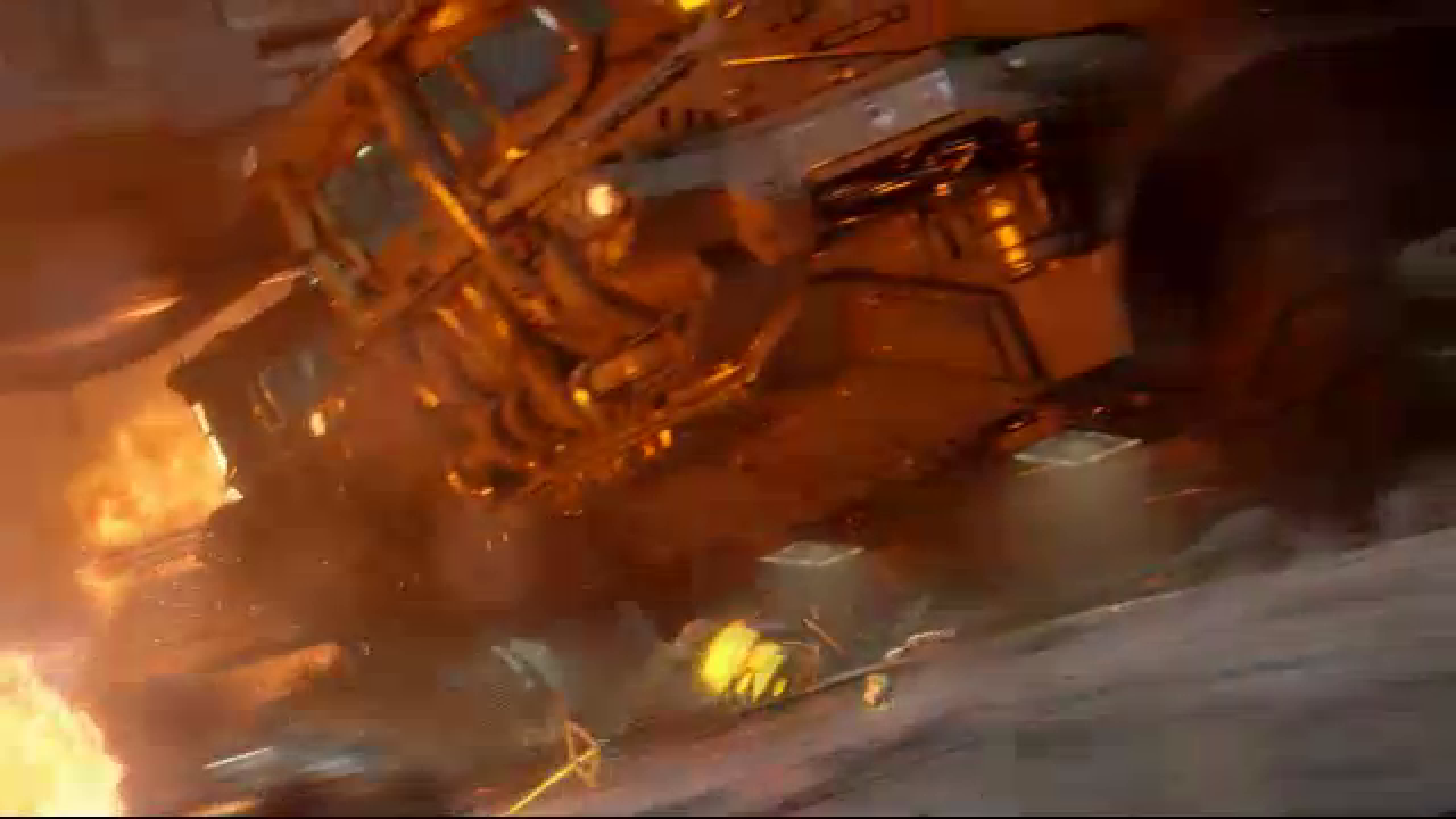
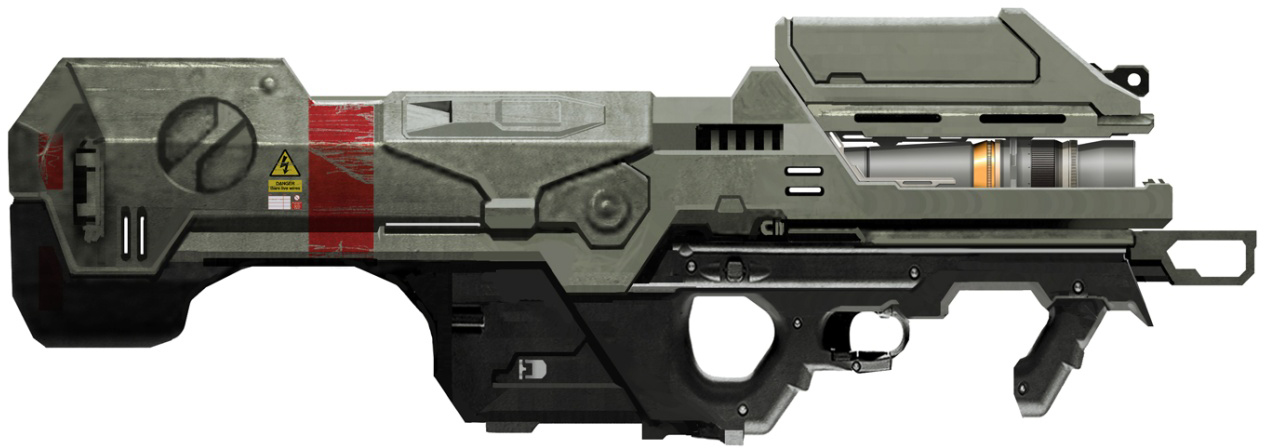
The Haloverse utilizes lasers to a varying degree. None is known better than the Spartan Laser, or Splaser as it is known to some. The Splaser is a portable shoulder mounted weapon with precision and high energy output. It is capable of killing anything up to the largest ground based vehicles in one shot. Though it may take a another shot for vehicles such as a Wraith of Scorpion. The Spartan Laser’s full name is the Weapon/Anti-Vehicle Model 6 Grindell/Galilean Nonlinear Rifle, (abbreviated W/AV M6 G/GNR).

The Spartan Laser is powered by a BA-53635/PLMD non-replaceable battery. Even though the name of the weapons implies use by Spartans, it has been used by ODSTs and marines alike. The Splaser utilizes a laser scope to help the user direct their shot to the intended target. The splaser uses a charging system, similar to real-life pulse lasers. Once charged, the Splaser delivers a devastating directed laser many magnifications higher than is known and/or used presently. Unlike present day lasers, the Splaser makes use of an auditory function to let the user know of impending discharge of the weapon. The total charge time takes roughly 2.5 seconds.
The Splaser is not a one beam weapon. In fact it is several smaller beams shot quickly to give the appearance of one intense beam.
The Spartan Laser though powerful and deadly is limited by the amount of shots it can produce, due to the battery.
Summation:
It is clear given the information in the factual section that lasers not only exist (and have for some time now), but can also be weaponized. No doubt a laser of today has the same if not more destructive firepower of a Spartan Laser. However, these are huge and no where near ready to be utilized as a shoulder mounted weapon. Given the advances of science in the past century it is reasonably plausible that a weapon such as the Spartan Laser will exist by the time period of the Haloverse.
-Sal