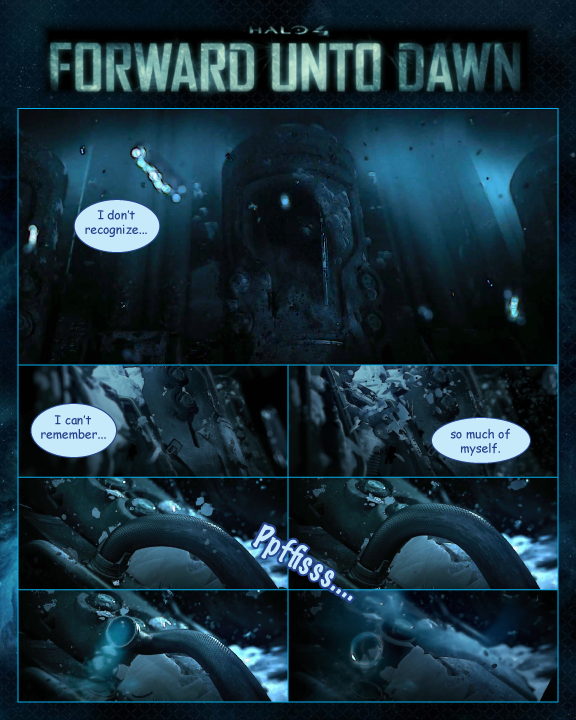
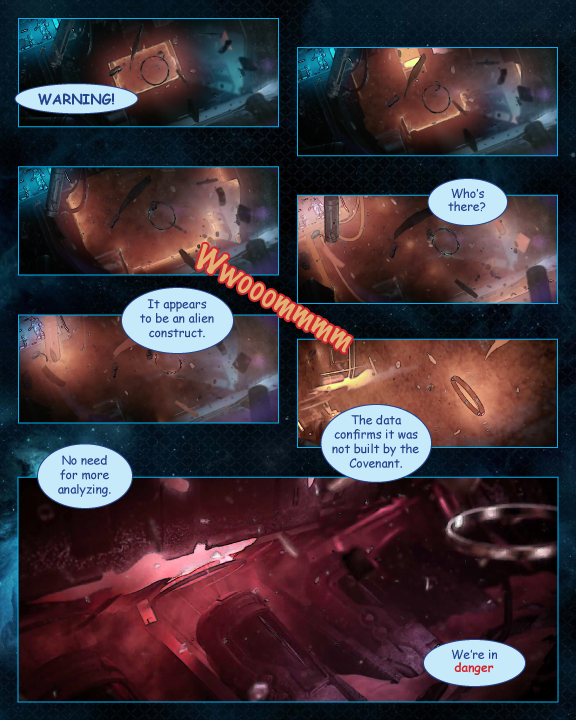
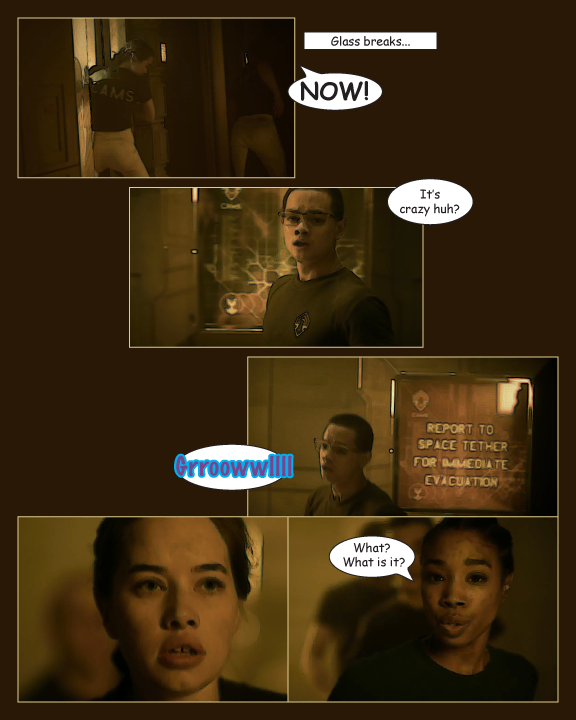
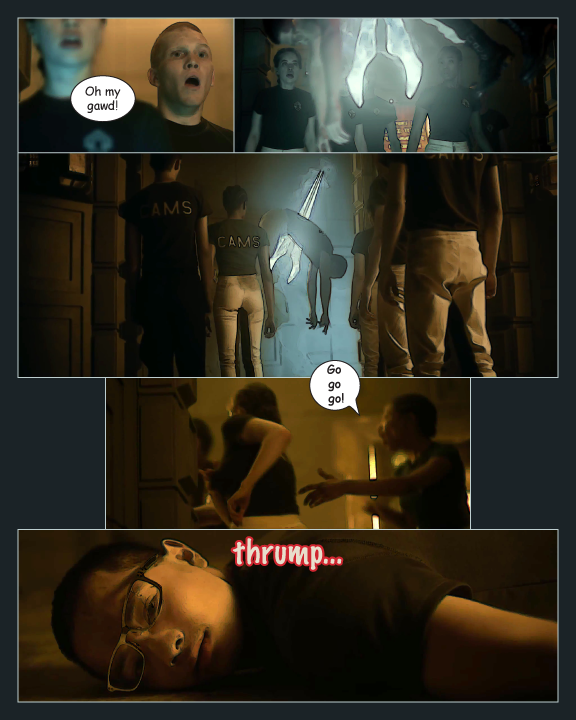
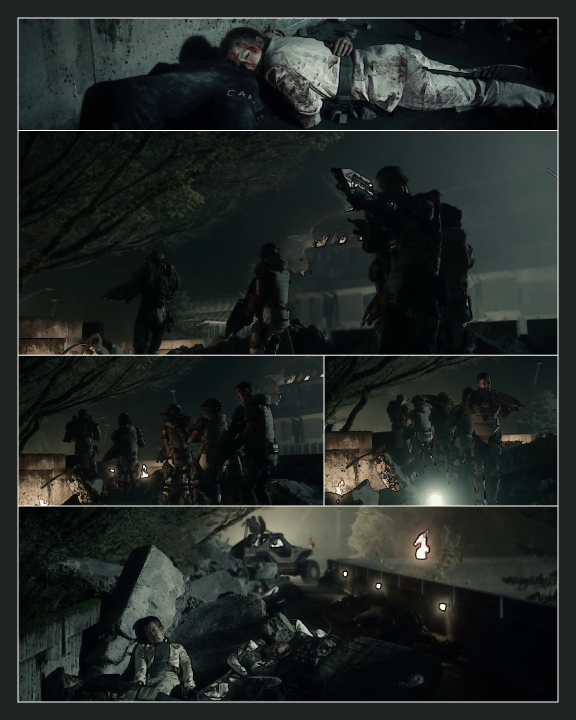
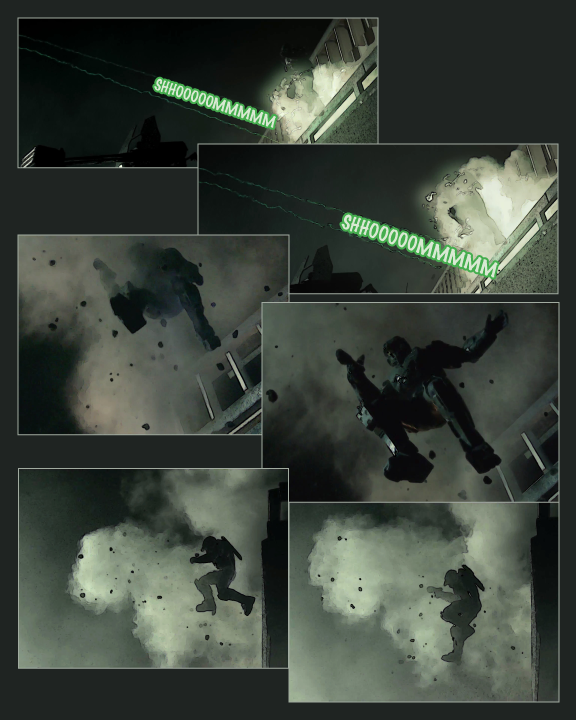
Forward Unto Dawn (unofficial) Graphic Novel: Episode 4

Friday I brought to you my 11-part review of the fourth episode of “Forward Unto Dawn.”

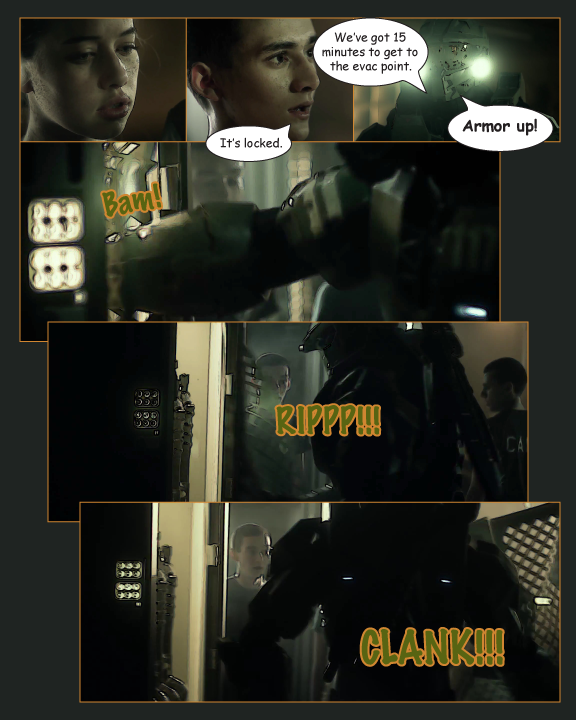
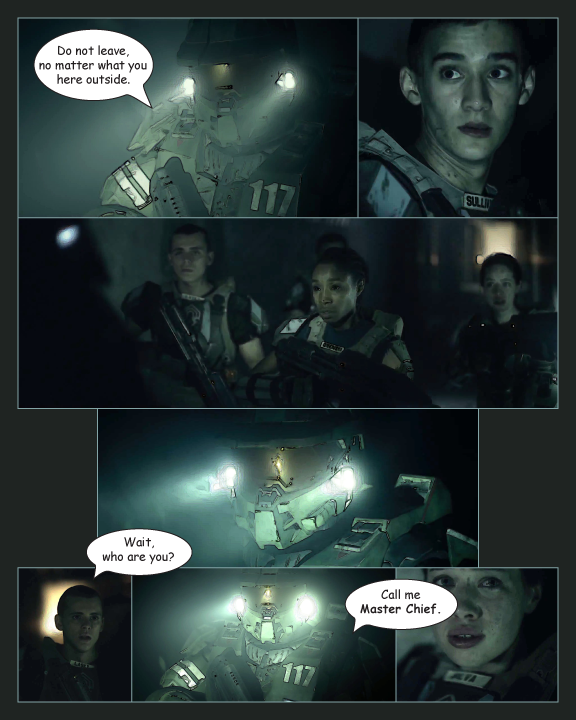
I’ve taken that a step further and made a 56-page graphic novel of the fourth episode. My biggest to date. Using the 343 screenshots I took as well as typing out some the dialog, I added Photoshop effects and laid out the project in InDesign.

Feel free to download this as it’s FREE. If you repost this anywhere, PLEASE give me credit as: Designed by Sal Salerno of HaloFanForLife.com
And please link back to my original post here.

Click on the first page. When the new window loads up, click the image to get to the next page, etc…

Without further ado:

This was an intese labor of love this time around as I had to deal with illness and Hurricane Sandy knocking out power three times. I really enjoyed making this though. Again, if you have any comments, please feel free to respond here, on Twitter, Facebook, or e-mail me at: sal@halofanforlife.com

-Sal (HFFL)

Forward Unto Dawn episode 2 11-part review coming shortly.

I just finished a Podcast with POD Dust Storm, so that held me back a little on getting the reviews done. I know 11 seems like a lot, however there were some very important if short scenes that need to be review separately. That is why there are so many parts.

As well I had to edit over 200 screenshots for the reviews.

After the reviews are done, I’ll get the graphic novel for episode 2 done, but that definitely won’t be until tomorrow.

-Sal

Back from New York Comicon!

Okay folks I have LOTS to discuss. I’ve got to write it all up. Here’s what you can expect over the course of the next two days:

• My “diary” of events of the trip. This will be a series of articles that will be more than just Halo related. It hopefully will read more like a story of my trip.
• Summary of New York Comicon. Think of this as the “Cliff Notes” version of above that pertains to the Con itself with more Halo highlights.
• Halo specific related convention news.
• A VERY Special Halo LAN/after party with pics and some great news about Halo 4 and Halo Mega Bloks.
• Thank you articles for those who helped me along the way during the con.
• Cosplay people! (Pics)

Beyond the convention stuff, I’m also going to squeeze in a multipart review of Forward Unto Dawn episode two, much like I did for the first episode. To follow in a day or two will be the unofficial Graphic Novel for episode two as well.

As I said, LOTS to do, so be patient please and I’ll get to blogging all this stuff momentarily.

-Sal

Superfan Symposium: An interview with Halo Superfan, Rich Bubik (aka Goodwill Hunter)

Just outside of Milwaukee, WI., Rich is a Creative Supervisor for a packaging company’s in-house Marketing department.

So you may be asking, Rich who? Well folks, he is one of if not the BEST custom Halo Mega Bloks model builder out there. My interviews of fans are not just those of MLG fandom or super website fame. They are of those who I feel have a positive impact on the Halo community and/or have a talent related to Halo that if not known, NEEDS to be known. Once you read this interview and see his creations, I hope you’ll feel the same that he belongs in the category of Halo Superfan.

Below you will see various pics of his customs. First up is what I consider to be his best. Certainly it’s his biggest. The Scarab.

HaloFanForLife (HFFL): When did you first become a Halo fan?
Rich Bubik (GH): I was a fan of Marathon on the Mac, so was looking forward to Halo all along. As soon as I found a used Xbox at my local second hand game shop (I rarely buy anything new or at full price – charter member at cheapassgamer.com), I picked it and a copy of Halo up, and have been a big fan ever since.

HFFL – Nothing wrong with being thrifty. Nice to see you were a fan of Bungie’s stuff before they blew up in fame with halo.

(HFFL): What about Halo made you a fan in the first place?
(GH): I’ve enjoyed first person shooters since Wolfenstein, so playing Halo was a given. The play mechanics, storyline and music, however, are what made me fall in love with the Halo universe.
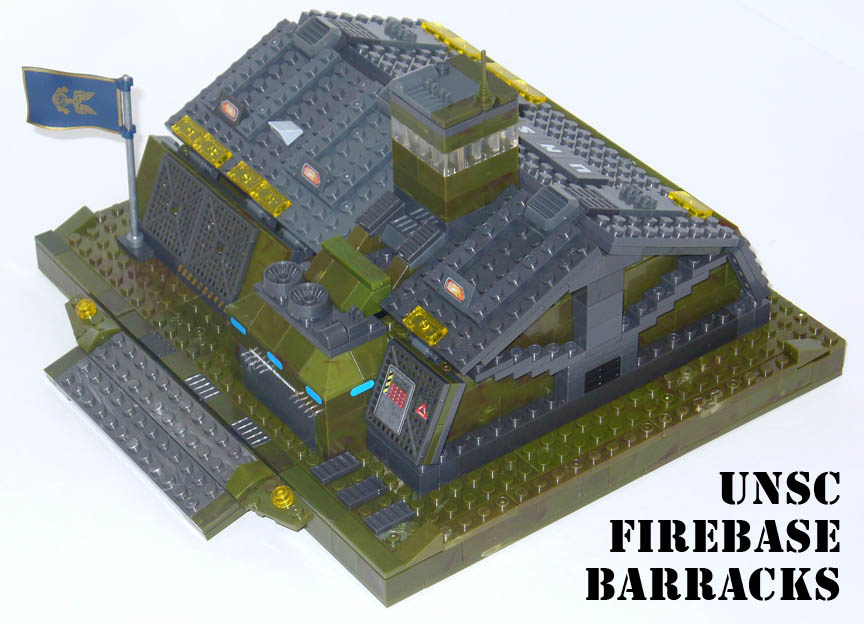
HFFL – The UNSC Barracks is but one of the buildings from Halo Wars. I’d LOVE to see Mega Bloks make all of the UNSC buildings. If not this scale, then a mini scale.

(HFFL): Of the games that there have been achievements for, have you completed them all?
(GH): I’m more about enjoying the campaign and checking out the maps than the achievements. I’ve been able to complete all of the Halo games on their highest difficulty level, but it usually is a long, leisurely process with lots of exploration. If I had to guess, I probably have somewhere north of half of the achievements in these games.

HFFL – Enjoying the games is what it’s all about. There are many ways to do that of course. Nice to see someone who doesn’t take is all as serious as some others do.

(HFFL): Which game in the Halo franchise is your favorite and why?
(GH): I’m probably one of the few people who will say this…but it’s Halo Wars.  In addition to being an FPS player, I also enjoy RTS games (my two favorite acronyms!) and am a huge fan of Dune: Battle for Arrakis on the Sega Genesis. As the play mechanics for Dune and Halo Wars are very similar, I fell in love with the game right away. In addition to providing so much fodder for the builds I have done, I really like the story and the characters in Halo Wars. Sgt. Forge is probably my favorite character in the Halo universe, and I was very moved by his sacrifice. And that battle between the Spartans and the Elite Honor Guard is my favorite video game cutscene of all time!


HFFL – I have been amassing green camo bloks myself to attempt a custom of the Vulture. Such an impressive ship, and GH did an amazing job in his custom.

(HFFL): What is your favorite Multiplayer game type and why? (ie., Team Slayer, FFA, BTB, Infection, etc.)
(GH): Slayer if I had to pick one…don’t play multiplayer all that much though.

(HFFL): Favorite Weapon from any of the Halo games and why?
(GH): Love the Gravity Hammer…the sound and the effects are hard to beat – but in game, I can’t get enough of the sniper rifle…prefer to thin the herd before charging in.

(HFFL): What are you most excited about for Halo 4?
(GH): Cortana getting her rage on…(and new vehicles to build!)

HFFL – I hear ya man. Cortana freakin’ out is something I’m most looking forward to as well. Heh, and new vehicles. While, I may not be as good a customizer as you are, I agree there are going to be some cool new vehicles. I just hope I don’t have to custom make them…
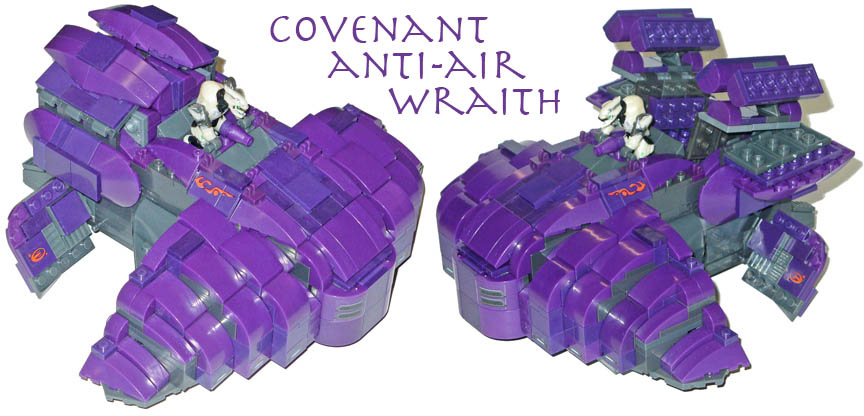

(HFFL): What do you think about the changes 343 is making to Halo?
(GH): Trying to keep an open mind…the new enemies and weapons look interesting, but what I’ve seen of the Mammoth doesn’t strike me as much of a Halo-type vehicle – perhaps that will change when I see it in action.

HFFL – Hmm, I like the Mammoth. More of a closed top Elephant. Bigger too. If I recall, I’ve heard it’s important to Spartan Ops, so we’ll likely see it a bit.

(HFFL): Where are you pre-ordering the game from (assuming you are pre-ordering)?
(GH): Whoever has the best deal…usually Amazon for me.

(HFFL): You have an impressive talent for creating custom Halo MEGA Bloks sets. Where did you get this talent from?
(GH): I’ve been a model builder my entire life. Built, weathered and customized Star Wars, Battlestar Galactica, Star Trek, and any other model kits I could get my hands on when I was a kid. I wanted to work for George Lucas making models for movies, but that, along with dreams of digging up dinosaurs for a living, did not come to pass. But aside from putting together a few models for work and school presentations, or playing legos with my daughters, I hadn’t done any real building for almost 20 years…until I came across a Halo Mega Bloks set during a Goodwill hunt, that is…

(HFFL): How long have you been making these customs?
(GH): My first custom build was the Covenant Revenant, made in February of 2011 from a Wraith set I found at my local Goodwill. I was at Goodwill, by the way, hunting for vintage video games, which is where my forum handle, Goodwill Hunter, comes from.  My first love, in terms of hobbies, is collecting classic video games…and thrift stores, rental locations, second-hand shops and rummage sales are where most of my collection originated. In 20 years of collecting and playing, I’ve amassed nearly 6,000 unique titles for nearly 50 systems, spanning the Atari 2600 to the Xbox 360, and everything in between. Believe it or not, I keep my video game and custom build collections in a 10’ x 12’ room, which also requires building a lot of custom shelving…but this effort has helped to ensure a happy home (the married guys know what I’m talking about).

HFFL – Sounds like me and my toy collections. Nice job on the amount of video game titles!

(HFFL): How do you go about starting to make a custom?
(GH): I start every custom build the same way, by finding as many images of the vehicle or structure as I can online, and printing them all out (unless I’m building something I just dreamed up, like the Mastodon or Dragonfly, because all of those pictures are only in my head). I then look at the pictures and try to imagine what existing bloks would work best to match what I see in the pictures. Getting good guide images to work from is the most important step in creating a successful custom build, IMHO.

HFFL – Above is his own creation, the “Mastadon.” It’s a mobile MAC Cannon platform. Very cool idea. Wouldn’t it be something if this made it into a Halo game?

(HFFL): Do you plan it out first? Or do you just start to build?
(GH): Researching the guide images is about all the planning I do. Once I have them, I just start putting pieces together, trying to match the guide images as closely as possible. Sometimes I go front to back, sometimes it’s bottom to top, and sometimes I build in sections that then need to be knit together. Sometimes it is seemingly endless trial and error (sections of the Vulture build were torn down and rebuilt dozens of times), and other times everything just seems to click on the first try (the Mastodon went together like I had a set of instructions in front of me for some reason).

HFFL – I hear ya on having to rebuild something over and over. I must have done that a couple dozen times to one of my customs before I felt it was where I wanted it to be. When creating, one should not rush to get it done. There is much to learn from having patience.

(HFFL): Do you figure out what parts you need and if you don’t have them where do you get them from?
(GH): All my spare parts are sorted by color in bags or bins. Much of my build time is spent sorting through piles of bloks looking for a certain piece. If I don’t have that certain piece, I usually try to find another way to execute that part of the build using the pieces I do have. Most of my parts come from sets bought on clearance (I couldn’t have made the Scarab without that Walmart clearance sale earlier in the year)– and BOGO sales combined with the occasional $5 Mega Bloks coupons are helpful in acquiring parts for customs.  I also keep an eye on Ebay for cheap lots of older vehicles or boxes of unassembled pieces.

(HFFL): How many Halo MEGA Bloks customs have you made?
(GH): I just put together a couple of YouTube videos that feature the 25 or so custom builds I have made since February of 2011.
http://www.youtube.com/watch?v=9JibRkVyZUU&feature=plcp
http://www.youtube.com/watch?v=oXtzrFRcjjw

HFFL – Impressive videos of your customs to say the least.

(HFFL): Which is your favorite and why?
(GH): That’s a tough one…I like the Revenant because it was the first one I did, the Vulture for its working missiles, the Scarab for it’s size, the Darters for their obscurity, the Spirit because no one else has attempted one, the Reactor for its detail, the Mastodon for the concept…I like them all for many different reasons – part of the reason I’ve chosen not to take them apart or sell them…guess I don’t really have a favorite.

(HFFL): (This one comes from a friend who wants me to ask) Do you work for MEGA Bloks? (The company)
(GH): No…I keep waiting for someone from Mega Brands to come to Milwaukee and throw money at me, but it has yet to happen.

HFFL – Heh, a man with the same desires as I have. Though I’m in Pittsburgh…

(HFFL): If no, would you like to work for them?
(GH): Of course! That would go a long way towards healing my previously mentioned Lucasfilm and Archeology wounds!

(HFFL): What one Halo MEGA Bloks set are you most looking forward to getting and why?
(GH): I am really looking forward to the Covenant Spirit that has been hinted at. I’m curious to see how the final compares to the prototype that was shown, and how they deal with some of the structural issues I encountered while building mine.

(HFFL): What vehicle/scene/playset would you like MEGA Bloks to make that hasn’t been made yet?
(GH): I would love to see a set of mini-scaled heavyweight ships from the Halo universe like the Pillar of Autumn and the Spirit of Fire, among others. If they had done that with their new die-cast line, I bet they would have sold a ton of them. The Infinity set looks promising, but I fear what the final price will be when it hits the shelf at TRU.

HFFL – There will indeed be models of some of the bigger ships (not to scale with the rest of the Halo Mega Bloks line). The first one is slated later this year, called the “Forward Unto Dawn.” It is touted as being the first in a new line called the “Signature Series.”

(HFFL): What else would you like to tell my readers either about you or your fascination with Halo/Halo MEGA Bloks?
(GH): I still make engine and weapon noises when I move the vehicles I make…my wife thinks I’m nuts, but tolerates me and my obsessions for the most part.

(HFFL): Any shout outs or links you’d like to say?
(GH): I’d like to thank Ernie for originally inviting me to share my builds on the fan site he created – SpartanBloks.com. Thanks also go out to Mega Bloks for giving my customs some recognition by awarding “Authorized Personnel Only” – my toymation contest entry, an honorable mention for best builds. And I’d like to thank anyone who has ever helped me get some sets or parts for my builds, or left me a comment or feedback on one of my posts or videos.


Find my custom build collection thread on SpartanBloks here.
Videos of my custom builds can be seen on my YouTube Channel here.
And lest I seem ungracious, thank you very much for the interview…I enjoy your site and discussing my interests (or obsessions as my wife would say) was a lot of fun!

HFFL – Pleasure to interview a talented fan such as yourself. And yeah, my wife thinks I’m obsessed too…

You can many more photos of GH’s customs here: Flick.com

For now here are some more examples of his work:



That last one (Nightingale), I’m particularly fond of. Not just a swap of red and white blocks from the Target exclusive and Arctic version. This just begs to be made as a real set for the masses. Well, pretty much all of his customs do.

Is that Scarab amazing or what??

-HFFL

 

Final Book in the Halo: Forerunner Saga Revealed! Halo: Silentium

Text from Tor.com

Tor Books has just announced the title, first cover, and release date for the third novel in the New York Times bestselling Halo Forerunner Saga, Halo: Silentium, written by legendary science fiction author Greg Bear. The first two books of the Forerunner Saga, Halo: Cryptumand Halo: Primordium are currently available in trade paperback, e-book, and audiobook. This newest book in the series will release in hardcover from Tor on January 8, 2013 alongside simultaneous audio and e-book editions.

In Halo: Cryptum, Greg Bear began a three-book arc set in the era of the Forerunners, the ancient and enigmatic creators and builders of the Halos, which continued in Halo: PrimordiumNow, in the last years of the Forerunner empire, chaos rules. The Flood—a horrifying shape-changing parasite—has arrived in force, aided by unexpected allies. Internal strife within the ecumene has desperately weakened Forerunner defenses.

Only the Ur-Didact and the Librarian—husband and wife pushed into desperate conflict—hold the keys to salvation. Facing the consequences of a mythic tragedy, one of them must now commit the greatest atrocity of all time—to prevent an unmatched evil from dominating the entire universe.

Tor Books has proudly partnered with Microsoft and 343 Industries to publish every book set in this iconic universe. Along with the books of the Forerunner Saga, Tor also publishes another all-new Halo trilogy penned byNew York Times bestselling author Karen Traviss that explores the Halo Universe in the wake of the final events of Halo 3. Traviss’s first novel, Halo: Glasslands, came out in 2011, with Halo: The Thursday War due out in October 2012.

/end copy/paste

I don’t know about you folks, but I’m REALLY excited to read this last in the trilogy of books. The cover art is amazing and gives us yet another glimpse into the scope and size of Forerunner technology.

-HFFL
‘Halo 4: Forward Unto Dawn’ will be the first ‘Halo’ movie

Text from herocomplex.latimes.com by Ben Fritz

Microsoft’s blockbuster “Halo” franchise has sold more than 42 million video games and been featured in novels, comic books, trading cards and an animated series. But Master Chief, the “space marine” protagonist who wields two guns and takes no prisoners, got his butt kicked on his first foray into the live-action world, when 20th Century Fox and Universal Pictures’ 2006 attempt to develop a big-budget “Halo” movie fizzled over budget concerns.

Now “Halo” has gone in front of the cameras, but without any movie studio assistance. Microsoft has produced a Web series, called “Halo 4: Forward Unto Dawn,” which will premiere this October in five episodes leading up to the release of the “Halo 4” video game. The segments will then be collected, along with 15 minutes of additional footage, into a 90-minute feature film. Microsoft will announce “Forward Unto Dawn” and preview it to fans at Comic-Con International in San Diego during a panel Thursday.

Financed at a cost insiders pegged as between $5 million and $10 million, “Forward Unto Dawn” represents the technology giant’s first significant step forward into the traditional entertainment world. Its backers hope the step will allow 343 Industries, the Microsoft subsidiary that oversees everything “Halo,” to tell new types of stories and reach new audiences.

“We want this piece to do all the things that a game, by virtue of being a game, can’t,” said producer Lydia Antonini, a former Warner Bros. executive who is one of several experienced Hollywood hands Microsoft hired. “When you have real people, you can have real stakes and make connections.”

Produced over five weeks this past spring in Vancouver, “Forward Unto Dawn” is a prequel story that portrays the first invasion by the Covenant, an alien force that has been the primary enemy in “Halo” games thus far. Set in a military academy, the futuristic science-fiction series focuses on a young trainee who will also appear in “Halo 4” and other upcoming games.

The cast includes Australian actor Tom Green, relatively unknown in the U.S., as its lead. Daniel Cudmore, who played Colossus in two “X-Men” movies and was in the most recent “Twilight” film, costars as Master Chief. Other cast members aren’t household names but have appeared in everything from “Footloose” to “Supernatural” to “The Chronicles of Narnia.”

Director Stewart Hendler, who previously made the horror movie “Sorority Row” and science-fiction Web series “H+,” said his goal was to temper a franchise known in the game world for over-the-top action and grandiose plots.

“I wanted to bring a sense of reality and gravity to the world,” he explained while editing the series in a North Hollywood office. “Everything from the performances to the aesthetics should be tethered to a sense of authenticity and grittiness.”

Key to that ambition, the filmmakers said, was using computer effects as little as possible. All the “Halo” hardware — from Master Chief’s armor to the “MA5” gun, Warthog vehicle, and Pelican drop ship — was made with real materials.

“Our hope is that nobody will look at a frame of this and go, ‘Oh, that’s a green screen,’” said producer Josh Feldman. “We built a disproportionate amount of our sets and brought in a visual effects supervisor who won an Emmy for ‘The Pacific.’”

An inspiration, the filmmakers said, has been the popular live-action commercials used to promote previous “Halo” games. An ad for 2009’s “Halo 3: ODST” helped to win director Rupert Sanders the director’s job on this summer’s big-budget tentpole film “Snow White and the Huntsman.”

In producing “Forward Unto Dawn,” Microsoft is putting itself among a small group of video game companies expanding into the live-action world. After producing several live-action Web videos based on its “Assassin’s Creed” franchise, French game publisher Ubisoft recently recruited “X-Men: First Class” star Michael Fassbender to play the lead character in a movie version it is developing. Like “Halo,” the “Assassin’s Creed” movie is being developed without a Hollywood studio.

While the primary business of “Halo” is still selling video games, Microsoft executives say they don’t see their foray into live action as a purely promotional move. “It’s really important to us that this is a stand-alone product that can make money on its own,” said Matt McCloskey, director of franchise business management for 343.

Toward that end, Microsoft licensed 343 to Machinima.com, the game website and YouTube channel. That will be the only place to watch “Forward Unto Dawn” webisodes, beginning Oct. 5, save for Microsoft Xbox 360 consoles connected to the Internet.

When put together into a film, the “Halo” movie will be given away free with limited editions of “Halo 4,” and be available to rent or buy on DVD, Blu-ray and in digital stores.

Millions of hard-core “Halo” fans are sure to stream the episodes and scrutinize whether every detail is exactly right. Hendler said he exchanged hundreds of emails with staff at 343 during preproduction. “They were checking every costume stitch, the placement of LEDs on the guns, and the bevels on the visors,” he said.

But if “Forward Unto Dawn” meets the ambitions of its makers, it will also draw viewers who think warthogs are animals and a Master Chief can be found at Camp Pendleton.

“One of the things we’re trying to do is reach new audiences,” said 343 franchise development director Frank O’Connor. “If Mom watches, she’ll completely understand it.”

– Ben Fritz

The Science of Halo, Fact Versus Fiction: Slipspace Technology

Slipspace Technology

So most of us have wondered what it would be like to travel faster than the speed of light. Slipspace technology is yet another type of travel that portends to do so. Is it possible?

In this segment of the Science of Halo we’re going to take a look at common as yet fictional Faster Than Light (FTL) technologies and compare them with the fiction of Slipspace technology.

First let’s mention some of those common names:
Hypserspace: A reference in Star Wars, it’s really the dimension of space when traveling at FTL speeds and not the actual movement/motion of it.
Lightspeed: This is yet another term popularized by Star Wars and is one of the most commonly reffered to terms when talking about FTL drives.
Space-Time Distortion: A famous theory of this is the Alcubierre drive.
Warp Drive: Warp Drive is known from the Star Trek franchise. The United Federation of Planet starships use this type of FTL drive.
Slipspace: Known to Halo fans, it’s become even more popular with several mentions in Halo Reach.

FACT

Before delving into specific common references to FTL drives, take a look at this link:
http://en.wikipedia.org/wiki/Faster-than-light
It’s chock full of knowledge regarding FTL drives and other instances of things being faster than light, such as quantum mechanics, such as quantum entanglement. Here is another excellent link for knowledge of interstellar travel: http://en.wikipedia.org/wiki/Interstellar_travel

Hyperspace is defined as space of more than three dimensions. It was first thought to have been used in 1867. Again this is not the motion of faster than light, but rather the space FTL exists in…possibly.

Surprisingly when I look up “Lightspeed” I am very often directed to a link for Warp Speed or something else entirely different. So suffice to say that Lightspeed is defined as such. Traveling at the speed of light. A famous Star Wars quote by Han Solo talking about the Millennium Falcon goes something like this, “she’ll make .5 past lightspeed.” In this respect we are then led to believe that starships in the Star Wars galaxy are able to travel FTL.

Space-time distortion

(Taken from the link above) Although the theory of special relativity forbids objects to have a relative velocity greater than light speed, and general relativity reduces to special relativity in a local sense (in small regions of spacetime where curvature is negligible), general relativity does allow the space between distant objects to expand in such a way that they have a “recession velocity” which exceeds the speed of light, and it is thought that galaxies which are at a distance of more than about 14 billion light-years from us today have a recession velocity which is faster than light. Miguel Alcubierre theorized that it would be possible to create an Alcubierre drive, in which a ship would be enclosed in a “warp bubble” where the space at the front of the bubble is rapidly contracting and the space at the back is rapidly expanding, with the result that the bubble can reach a distant destination much faster than a light beam moving outside the bubble, but without objects inside the bubble locally traveling faster than light. However, several objections raised against the Alcubierre drive appear to rule out the possibility of actually using it in any practical fashion. Another possibility predicted by general relativity is the traversable wormhole, which could create a shortcut between arbitrarily distant points in space. As with the Alcubierre drive, travelers moving through the wormhole would not locally move faster than light which travels through the wormhole alongside them, but they would be able to reach their destination (and return to their starting location) faster than light traveling outside the wormhole.

What’s interesting about this theory (Alcubierre Drive) is that it’s likely the closest to slipspace technology and could indeed become feasible someday. Here is the theory summed up better:
The Alcubierre metric defines the warp drive spacetime. This is a Lorentzian manifold which, if interpreted in the context of general relativity, allows a warp bubble to appear in previously flat spacetime and move off at effectively superluminal speed. Inhabitants of the bubble feel no inertial effects. The object(s) within the bubble are not moving (locally) faster than light, instead, the space around them shifts so that the object(s) arrives at its destination faster than light would in normal space.

The above paragraph taken from this link:
http://en.wikipedia.org/wiki/Alcubierre_drive

Warp Drive

Take a look at this link from NASA that explains the current state of Warp Drives in reality:
http://www.nasa.gov/centers/glenn/technology/warp/warpstat.html

other links on Warp Drive:
http://www.space.com/6649-star-trek-warp-drive-impossible.html
http://en.wikipedia.org/wiki/Warp_drive_(Star_Trek)

FICTION

Here are three links regarding Halo’s Slipspace Technology.
http://halo.wikia.com/wiki/Shaw-Fujikawa_Translight_Engine
http://halo.wikia.com/wiki/Slipstream_Space
http://www.halopedian.com/Slipspace_drive

“They have opened a path to the stars for all of us.” — Tobias Fleming Shaw, ScD, QeD, FRS January 30, 2220 – November 10, 2317, Wallace Fujikawa ScD, QEnD April 20, 2215 – February 18, 2318

Wallace Fujikawa and Tobias Fleming Shaw are the two scientists noted for leading the team of engineers and theoretical physicist who created Slipspace technology in the Halo universe.

Shaw-Fujikawa drives create ruptures in space or mini wormholes. Passing through these wormholes acts as a shortcut through normal space by entering “slipspace,” thereby attaining FTL speeds. Hence, Auntie Dot in Halo Reach saying “Slipspace rupture detected.”

The following paragraph is taken from this link:
http://halo.wikia.com/wiki/Shaw-Fujikawa_Translight_Engine

The elements Selenium and Technetium are used to manufacture Shaw-Fujikawa Translight Engines. In the 2490s, the colony of Levosia was suspected of diverting the said elements to the black market. The ensuing UNSC blockade of the system and the Insurrectionist reaction eventually led to the Callisto Incident, which is said to have effectively sparked the Insurrection.

It should be noted that Covenant Slipspace is not only more accurate, but much faster than human slipspace tech. Forerunner tech is faster still.

In the same 24 hours each race’s slipspace tech can travel approximately:
Human 2.625 light years distant
Covenant 912.12 light years distant (nearly 350 times faster than human slipspace)
Forerunner 2371.2 light years distant (nearly 1,000 times faster than human slipspace)

Follow this link for more specifics on slipspace speeds: http://halo.wikia.com/wiki/Slipstream_Space#Velocities

SUMMATION

So is it possible to travel FTL in any form? Well not yet, though many scientists are working on some form of it. NASA is vested in some form of Warp Drive. It could be possible to have interstellar travel, albeit at greatly reduced speeds than FTL. This would require a generational starship that would allow many generations of BOB (Born on Board) humans to live, though they would only know life on the ship until the destination of a planet that would be habitable. Shielding would be required not just from space dust, but also the harmful radiation that permeates space. Given that this shielding is as yet not possible the likelihood that humanity will take to the stars for a long period of time is unlikely in the near future, though I would never say NEVER.

Here is another link for those interested in possibilities of FTL drives:
http://www.grc.nasa.gov/WWW/bpp/

Okay, so I know that’s a lot of technical stuff to digest, but that’s part of the point of these articles. Halo is SO much more than the video game, if you allow it to be. Getting a glimpse and/or understanding the Science of Halo from a realistic stand point allows you to be more immersed in the lore of Halo.

-HFFL

Interview with Norway’s Halo SUPER fan Maria Masuimi.

This fan interview is the first in what I hope is a long string of fan interviews. If you have a favorite Halo super fan you’d like to see me interview please comment below or send me an e-mail to sal@halofanforlife.com

For my first interview I had the pleasure of asking the beautiful and talented Maria Masuimi several Halo related questions that any Halo fan can relate to. Maria is a 25 year old Halo gamer living in Oslo, Norway, who works in public administration. She’s known on Twitter ( @MariaMasuimi ) and has been featured on HaloWaypoint.com. Her pic is the last (but not least) in that article.

Here’s a pic of her, used with permission (and fellas, please don’t gawk, it’s rude…):

HaloFanForLife (HFFL): When did you first become a Halo fan?
Maria Masuimi (MM): I recall trying Halo a decade ago, but I wasn’t truly captured by Halo until Halo 3 came around. I’ve played a lot of FPS’ in my life and never really had it has my favourite genre, but Halo kind of changed that for me.

HFFL: What about Halo made you a fan in the first place?
MM: It’s a very social game while being highly competitive with its mulitplayer and once you get into the “science” of that in all its details it’s not really an easy game to play. I think those two reasons makes the series appeal to a large number of people, including me. It’s hard to pinpoint exactly how it started, but I think a big part of the reason was that it was one of my first experiences with real memorable FPS co-op gameplay on a console.
Initially I mostly played campaign and it was just so fun being able to do missions with a full team and go through the struggles together with someone. But with time I got more and more into the multiplayer aspect, and that is ultimately the part that has kept me constantly coming back for more all these years.
Halo was also a nice shift of phase from the realistic military-themed shooters. I guess I have limits for how much camo fabric my eyes can take. And also, honestly, with age, a teeny-tiny percentage of me has started to slightly feel the sensation of “wrong” as I shoot realistic-looking people in FPS’. In Halo you don’t shoot something as similar looking to PEOPLE per se, which leaves that whole sensation out “you know this is wrong” of the picture. And it’s also nice to have superhuman strength and not be as bound by physical laws.

HFFL: How many Halo achievements have you completed?
MM:
• Halo CE: Anniversary?
I had quite some issues with insane lag in Anniversary. I’ve only completed 11 out of 44.
• Halo 3?
I have 45 of 79. I was a bit of a shitty player back in H3. (HFFL-I hear ya, so was I)
• Halo Wars?
I haven’t played it.
• Halo 3 ODST?
I had huge lag issues in ODST as well, but got 23 of 47.
• Halo Reach?
I have 62 of 69. Originally I would have had all achievements except for one (A Monument to all your sins), but then some new ones were added with Anniversary, and I haven’t had time to attempt all of the new ones yet.

HFFL: Which game in the Halo franchise is your favorite and why?
MM: That is so hard to answer, because I don’t have one favourite, more like favourite parts of each game. I think it stands between Halo 3 and Halo ODST. Gaming, to me, is very tightly connected with good memories. With Halo 3, I just have so many good (and frustrating) memories of trying to get through the game on all difficulties. It is the first game I recall actually playing a game for 10 hours straight till the sun came up. The ODST campaign, although I didn’t like it at first, grew on me. This might sound odd but I just get this really cosy feeling from playing ODST, it’s just so friggin cosy! Too bad about the heavy lag on co-op runs.

HFFL: What is your favorite Multiplayer game type and why? (ie., Team Slayer, FFA, BTB, Infection, etc.)
MM: I guess I’m a sucker for the simplest type of Multiplayer action, which is Slayer. I’ve never been a fan of objectives. In Reach my favourite slayer type was Squad Slayer, because it didn’t have the annoying Armor Lock, while having 10 players and 75 kills to win. I whined for a week when they removed it, before moving on to favouring Anniversary Big Team Battle instead.
In my perfect world we’d play slayer on smaller maps with more players, I thrive in chaotic carnage mayhem, because everyone has less control of what’s happening and so the traditional dynamics of team play gets somewhat distorted and less effective, so who wins is somewhat up in the air. I’m not really good at solid team play, tho I like playing in a team for the socialness of it.

HFFL: Favorite Weapon from any of the Halo games and why?
MM: My favourite weapon used to be the BR, but the DMR has suddenly become more and more desirable over time. Take away bloom, and it’s awesome. I just like how it fires single shots and the recticle makes for better precision (once bloom is out of the way).

HFFL: What are you most excited about for Halo 4?
MM: The campaign, actually. I try to avoid Halo 4 news as much as I can so that when I actually play it, most things will be new and exciting to me and hopefully surprise me. I’m also curious about Spartan Ops, and how abilities will affect multiplayer gameplay. Especially forerunner vision has potential to become a huge multiplayer headache. However, I won’t really critisize it until I’ve tried it. It might feel completely different when playing and might contribute to us having to adapt to new playstyles and ways of doing things. Which could suck, but it could also be awesome. Time will tell.

HFFL: What do you think about the changes 343 is making to Halo?
MM: I think there’s been a lot of skepticism from the community and the professional gaming community especially, which is only natural I suppose, but at times it seems people are so scared of and reluctant to change that their skepticism is crippling to game development itself.
Games evolve, it’s just what happens. It has to happen. A game released in 2012 should not feel and play as if it was released in 2001. I think if a game can’t be allowed to evolve, then what’s the point of making a new one? I think we need to learn and adapt to possibly be playing Halo in a new/different way than we have been so far.

HFFL: Where are you pre-ordering Halo 4 from?
MM: I kinda like the Rapture skin from Best Buy, so I’m thinking I might pre-order from there.

HFFL: Which Halo achievement has been your favourite or most frustrating one obtaining?
MM: Without a doubt “If They Came To Hear Me Beg” from Halo Reach. I jumped that Elite a total of 72 times before getting a perfect assassination and “survived a fall that would have been fatal.”
(HFFL – OMG, I HATED that one. You’re lucky it only took you  72 times. It took me upwards of 400 tries. Several of them I even assassinated that stinkin’ elite but it didn’t count. PLEASE 343, do not make an achievement like this. Most frustrating indeed)
HFFL: You’ve been fortunate to be featured in the Halo Bulletin with Halo illustrations. How did you feel when you found out about that?
MM: I’ve been just as excited each time, heart beating out of my chest! It is so admirable how 343 Industries make effort to truly embrace the Halo community, showing some love to both the new and the old!

Here’s the pic featured on HaloWaypoint, followed by a few others from Maria’s Twitter feed:

HFFL: Any shout outs or links you’d like to give?
MM: A shout out to everyone’s favourite Community Manager, Jessica “bs angel” Shea, just for being amazing. And my buddy Dan “Greenskull” Hammill who just partnered up with IGN (www.youtube.com/user/ReadyUpLive). Andrew Cook who makes awesome Halo weapon replicas (http://www.youtube.com/user/DaFrontlineTrooper).
(HFFL – I’ve had the pleasure of gaming with both bs Angel and Greenskull myself. Jessica laughs a lot. Several “That’s what she said,” jokes were made during one of those gaming sessions. Greenskull has a great site in ReadyUpLive and was recently honored with an in-game Halo 4 shout-out having to do with the hometown he’s from. Andrew has some AMAZING props. I’d love to commission him to make one for me.)

HFFL: Thanks Maria. It’s been a real treat to interview you and you have the distinction of being my first Halo Super Fan interview, here on HaloFanForLife.com.

And with that the interview came to a close. I hope you enjoyed the read as much as I enjoyed the interview itself.

Again, if you’d like to see a specific Halo super fan interviewed, please comment or e-mail me who you’d like to see and I’ll try my best to get an interview with them.

-HFFL
The Science of Halo, Fact versus Fiction: Spartan Laser

This is a LONG article with NO TL:DR section. Though you may want to scroll to the “Summation” section at the bottom of the article.

The following “Fact” section was taken directly from the links provided after specific sections. I did not include all the text from those links, electing to copy that which I felt was pertinent and reasonably understood by all. Please check out the links for much more information on Lasers.

Discliamer: I am not a scientist, so I may get some things wrong in this article. Now onto the article:

Fact
What is a Laser?
A laser is a device that emits light (electromagnetic radiation) through a process of optical amplification based on the stimulated emission of photons. The term “laser” originated as an acronym for Light Amplification by Stimulated Emission of Radiation. The emitted laser light is notable for its high degree of spatial and temporal coherence, unattainable using other technologies. In modern usage “light” broadly denotes electromagnetic radiation of any frequency, not only visible light, hence infrared laser, ultraviolet laser, X-ray laser, and so on. (Layman’s terms: Light is bounced back and forth at an accelerated speed between mirrors-one being partially transparent, light escaping this can be focus to form a laser.)

Spatial coherence typically is expressed through the output being a narrow beam which is diffraction-limited, often a so-called “pencil beam.” Laser beams can be focused to very tiny spots, achieving a very high irradiance. Or they can be launched into a beam of very low divergence in order to concentrate their power at a large distance.

Temporal (or longitudinal) coherence implies a polarized wave at a single frequency whose phase is correlated over a relatively large distance (the coherence length) along the beam.

Most so-called “single wavelength” lasers actually produce radiation in several modes having slightly different frequencies (wavelengths), often not in a single polarization. And although temporal coherence implies monochromaticity, there are even lasers that emit a broad spectrum of light, or emit different wavelengths of light simultaneously. There are some lasers which are not single spatial mode and consequently their light beams diverge more than required by the diffraction limit. However all such devices are classified as “lasers” based on their method of producing that light: stimulated emission. Lasers are employed in applications where light of the required spatial or temporal coherence could not be produced using simpler technologies.

How is a laser created/designed?
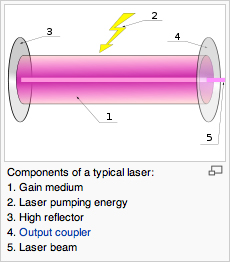
A laser consists of a gain medium, a mechanism to supply energy to it, and something to provide optical feedback. The gain medium is a material with properties that allow it to amplify light by stimulated emission. Light of a specific wavelength that passes through the gain medium is amplified (increases in power).

For the gain medium to amplify light, it needs to be supplied with energy. This process is called pumping. The energy is typically supplied as an electrical current, or as light at a different wavelength. Pump light may be provided by a flash lamp or by another laser.

The most common type of laser uses feedback from an optical cavity—a pair of mirrors on either end of the gain medium. Light bounces back and forth between the mirrors, passing through the gain medium and being amplified each time. Typically one of the two mirrors, the output coupler, is partially transparent. Some of the light escapes through this mirror. Depending on the design of the cavity (whether the mirrors are flat or curved), the light coming out of the laser may spread out or form a narrow beam. This type of device is sometimes called a laser oscillator in analogy to electronic oscillators, in which an electronic amplifier receives electrical feedback that causes it to produce a signal.

Most practical lasers contain additional elements that affect properties of the emitted light such as the polarization, the wavelength, and the shape of the beam.

The light emitted:
The beam in the cavity and the output beam of the laser, when travelling in free space (or a homogenous medium) rather than waveguides (as in an optical fiber laser), can be approximated as a Gaussian beam in most lasers; such beams exhibit the minimum divergence for a given diameter. (Think Gauss Hog’s laser).

The differences of a Red or Green laser are as such:
The red laser light has a longer wavelength (about 650 nanometers) than does the green (about 532 nanometers). The mechanism behind making them is also different. Red lasers use a diode, optics, and some electronics. These are fairly easy to make and assemble, so red lasers are cheap. The green laser, on the other hand, requires a special diode (an 808 diode for those who know their lasers), a second infrared laser crystal, and a frequency-doubling crystal. These have to be very carefully aligned in order for the laser to function properly.

For more info on the color of lasers please check out this link: http://www.physlink.com/education/askexperts/ae435.cfm

Pulse mode of operation:
Pulsed operation of lasers refers to any laser not classified as continuous wave, so that the optical power appears in pulses of some duration at some repetition rate. This encompasses a wide range of technologies addressing a number of different motivations. Some lasers are pulsed simply because they cannot be run in continuous mode.

In other cases the application requires the production of pulses having as large an energy as possible. Since the pulse energy is equal to the average power divided by the repetition rate, this goal can sometimes be satisfied by lowering the rate of pulses so that more energy can be built up in between pulses.

Other applications rely on the peak pulse power (rather than the energy in the pulse), especially in order to obtain nonlinear optical effects. For a given pulse energy, this requires creating pulses of the shortest possible duration utilizing techniques such as Q-switching.

In a Q-switched laser, the population inversion is allowed to build up by introducing loss inside the resonator which exceeds the gain of the medium; this can also be described as a reduction of the quality factor or ‘Q’ of the cavity. Then, after the pump energy stored in the laser medium has approached the maximum possible level, the introduced loss mechanism (often an electro- or acousto-optical element) is rapidly removed (or that occurs by itself in a passive device), allowing lasing to begin which rapidly obtains the stored energy in the gain medium. This results in a short pulse incorporating that energy, and thus a high peak power.

Pulsed pumping:
Another method of achieving pulsed laser operation is to pump the laser material with a source that is itself pulsed, either through electronic charging in the case of flash lamps, or another laser which is already pulsed. Pulsed pumping was historically used with dye lasers where the inverted population lifetime of a dye molecule was so short that a high energy, fast pump was needed. The way to overcome this problem was to charge up large capacitors which are then switched to discharge through flashlamps, producing an intense flash.

http://en.wikipedia.org/wiki/Laser

Gas Dynamic Laser:
Gas Dynamic Laser (GDL) is laser based on differences in relaxation velocities of molecular vibrational states. The laser medium gas has such properties that an energetically lower vibrational state relaxes faster than a higher vibrational state, thus a population inversion is achieved in a particular time.

Pure Gas dynamic lasers usually use a combustion chamber, supersonic expansion nozzle and CO2 as an active laser medium in mixture with nitrogen or helium. Gas dynamic laser could be however pumped not only by combustion, but by any adiabatic expansion of gas. Any hot and compressed gas with appropriate vibrational structure could be utilized.

Explosively pumped gas dynamic laser is a version of gas dynamic laser pumped by expansion of explosion products. Hexanitrobenzene and/or tetranitromethane with metal powder is preferred explosive. This device could have very high pulse peak power output applicable in laser weapons.

How a Gas Dynamic Laser Functions:

1. Hot compressed gas is generated.
2. Gas expands through subsonic or supersonic expansion nozzle, the temperature of the gas becomes lower and according to maxwell–Boltzmann distribution the gas isn’t in thermodynamic equilibrium until the vibrational states relax.
3. The gas flows through the tube of a particular length for a particular time. In this time lower vibrational state does relax but higher vibrational state doesn’t. Thus population inversion is achieved.
4. Gas flows through mirror area where stimulated emission takes place.
5. Gas returns to equilibrium and becomes warm. It must be removed from the laser cavity or it will interfere with the thermodynamics and vibrational state relaxation of the freshly expanded gas.

http://en.wikipedia.org/wiki/Gas_dynamic_laser

Operational Advantages of Lasers:
Laser weapons could have several main advantages over conventional weaponry:

  • Laser beams travel at the speed of light, so there is no need (except over very long distances) for users to compensate for target movement when firing over long distances. Consequently, evading a laser after it has been fired is impossible.
  • Because of the extremely high speed of light it is only slightly affected by gravity, so that long range projection requires little compensation. Other aspects such as wind speed can be neglected at most times, unless shooting through an absorption matter.
  • Lasers can change focusing configuration to provide an active area that can be much smaller or larger than projectile weaponry.
  • Given a sufficient power source, laser weapons could essentially have limitless ammunition.
  • Because light has a practically nil ratio (exactly 1/c) of momentum to energy, lasers produce negligible recoil.
  • The operational range of a laser weapon can be much larger than that of a ballistic weapon, depending on atmospheric conditions and power level.

Blooming of a Laser:
Laser beams begin to cause plasma breakdown in the air at energy densities of around a megajoule per cubic centimeter. This effect, called “blooming,” causes the laser to defocus and disperse energy into the atmosphere. Blooming can be more severe if there is fog, smoke, or dust in the air.

Reducing blooming:

  • Spread the beam across a large, curved mirror that focuses the power on the target, to keep energy density en route too low for blooming to happen. This requires a large, very precise, fragile mirror, mounted somewhat like a searchlight, requiring bulky machinery to slew the mirror to aim the laser.
  • Use a phased array. For typical laser wavelengths this method requires billions of micrometre-size antennae. No way to make these is known. However, carbon nanotubes have been proposed. Phased arrays could theoretically also perform phase-conjugate amplification (see below). Phased arrays do not require mirrors or lenses, can be made flat and thus do not require a turret-like system (as in “spread beam”) to be aimed, though range will suffer at extreme angles (that is, the angle the beam forms to the surface of the phased array).
  • Use a phase-conjugate laser system. Here, a “finder” or “guide” laser illuminates the target. Any mirror-like (“specular”) points on the target reflect light that is sensed by the weapon’s primary amplifier. The weapon then amplifies inverted waves in a positive feedback loop, destroying the target with shockwaves as the specular regions evaporate. This avoids blooming because the waves from the target passed through the blooming, and therefore show the most conductive optical path; this automatically corrects for the distortions caused by blooming. Experimental systems using this method usually use special chemicals to form a “phase-conjugate mirror“. In most systems, the mirror overheats dramatically at weapon-useful power levels.
  • Use a very short pulse that finishes before blooming interferes.
  • Focus multiple lasers of relatively low power on a single target.

High Power Consumption:
One major problem with laser weapons (and directed-energy weapons in general) is their high electric energy requirements. Existing methods of storing, conducting, transforming, and directing energy are inadequate to produce a convenient hand-held weapon. Existing lasers waste much energy as heat, requiring still-bulky cooling equipment to avoid overheating damage. Air cooling could yield an unacceptable delay between shots. These problems, which severely limit laser weapon practicality at present, might be offset by:

  1. Cheap high-temperature superconductors to make the weapon more efficient.
  2. More convenient high volume electricity storage/generation. Part of the energy could be used to cool the device.

Weaponized lasers of the present:
Pulsed Energy Projectile or PEP systems emit an infrared laser pulse which creates rapidly expanding plasma at the target. The resulting sound, shock and electromagnetic waves stun the target and cause pain and temporary paralysis. The weapon is under development and is intended as a non-lethal weapon in crowd control.

• Made by Northrop Grumman:

  • On March 18, 2009 Northrop Grumman announced that its engineers in Redondo Beach had successfully built and tested an electric laser capable of producing a 100-kilowatt ray of light, powerful enough to destroy cruise missiles, artillery, rockets and mortar rounds. An electric laser is theoretically capable, according to Brian Strickland, manager for the United States Army‘s Joint High Power Solid State Laser program, of being mounted in an aircraft, ship, or vehicle because it requires much less space for its supporting equipment than a chemical laser.
  • On April 6, 2011, the U.S. Navy successfully tested a laser gun, manufactured by Northrop Grumman, that was mounted on the former USS Paul Foster, which is currently used as the navy’s test ship. When engaged during the test that occurred off the coast of Central California in the Pacific Ocean test range, the laser gun was documented as having “a destructive effect on a high-speed cruising target,” said Chief of Naval Research Admiral Nevin Carr.[10] While classified, the range of the laser gun is attributed to miles, not yards.
  • Northrop Grumman has announced the availability of a high-energy solid-state laser weapon system that they call FIRESTRIKE, introduced on 13 November 2008. The system is modular, using 15 kW modules that can be combined to provide various levels of power.

• On 19 July 2010 an anti-aircraft laser described as the Laser Close-In Weapon System was unveiled at the Farnborough Airshow.
• The Mid-Infrared Advanced Chemical Laser (MIRACL) is an experimental U.S. Navy deuterium fluoride laser and was tested against an Air Force satellite in 1997.
• In 2011, the U.S. Navy began to test the Maritime Laser Demonstrator (MLD), a laser for use aboard its warships.
• Personnel Halting and Stimulation Response, or PHaSR, is a non-lethal hand-held weapon developed by the United States Air Force. Its purpose is to “dazzle” or stun a target. It was developed by Air Force’s Directed Energy Directorate.
• Tactical High Energy Laser (THEL) is a weaponized deuterium fluoride laser developed in a joint research project by Israel and the U.S. It is designed to shoot down aircraft and missiles. See also National missile defense.
• The U.S. Air Force’s Airborne Laser, or Advanced Tactical Laser, is a plan to mount a CO2 gas laser or COIL chemical laser on a modified Boeing 747 to shoot down missiles
http://en.wikipedia.org/wiki/Directed-energy_weapon

Fiction:
The Haloverse utilizes lasers to a varying degree. None is known better than the Spartan Laser, or Splaser as it is known to some. The Splaser is a portable shoulder mounted weapon with precision and high energy output. It is capable of killing anything up to the largest ground based vehicles in one shot. Though it may take a another shot for vehicles such as a Wraith of Scorpion. The Spartan Laser’s full name is the Weapon/Anti-Vehicle Model 6 Grindell/Galilean Nonlinear Rifle, (abbreviated W/AV M6 G/GNR).

The Spartan Laser is powered by a BA-53635/PLMD non-replaceable battery. Even though the name of the weapons implies use by Spartans, it has been used by ODSTs and marines alike. The Splaser utilizes a laser scope to help the user direct their shot to the intended target. The splaser uses a charging system, similar to real-life pulse lasers. Once charged, the Splaser delivers a devastating directed laser many magnifications higher than is known and/or used presently. Unlike present day lasers, the Splaser makes use of an auditory function to let the user know of impending discharge of the weapon. The total charge time takes roughly 2.5 seconds.

The Splaser is not a one beam weapon. In fact it is several smaller beams shot quickly to give the appearance of one intense beam.

The Spartan Laser though powerful and deadly is limited by the amount of shots it can produce, due to the battery.

Summation:
It is clear given the information in the factual section that lasers not only exist (and have for some time now), but can also be weaponized. No doubt a laser of today has the same if not more destructive firepower of a Spartan Laser. However, these are huge and no where near ready to be utilized as a shoulder mounted weapon. Given the advances of science in the past century it is reasonably plausible that a weapon such as the Spartan Laser will exist by the time period of the Haloverse.

-Sal