343 has just released 3 videos of Halo 4. This is the first of those three:
Here’s my reaction while watching it for the first time:

343 has just released 3 videos of Halo 4. This is the first of those three:
Here’s my reaction while watching it for the first time:

I compiled this large poster to illustrate the state of my mind after watching the Halo 4 trailer from E3 2012 (And yes, it’s busy as hell, but if you saw the trailer, then you know why!):
Click to make bigger.

I actually have a MUCH larger version available for download. You can check that out at my Flickr account:
11X17 poster with bleeds at 300dpi
If you use this for a website, please give credit to me: Sal Salerno (HaloFanForLife.com)
I hope you like it. As i said, I know it’s busy, but that was the state of my mind immediately after watching the trailer.
-HFFL
Want proof? See below:

Quoting Frank O’Conner on his post from NeoGaf:
“10 is only referring to non forge maps/environment.”
Hmm, so is this besides the additional maps you get with the limited edition? Wow, if so, then we’ll have near 20 maps, PLUS Forge World maps. Uhh, I think I just fainted.
Here are the final screenshots I took of the trailer.
A Promethean Knight staring Master Chief down:

Cortana (looking good might I add.)
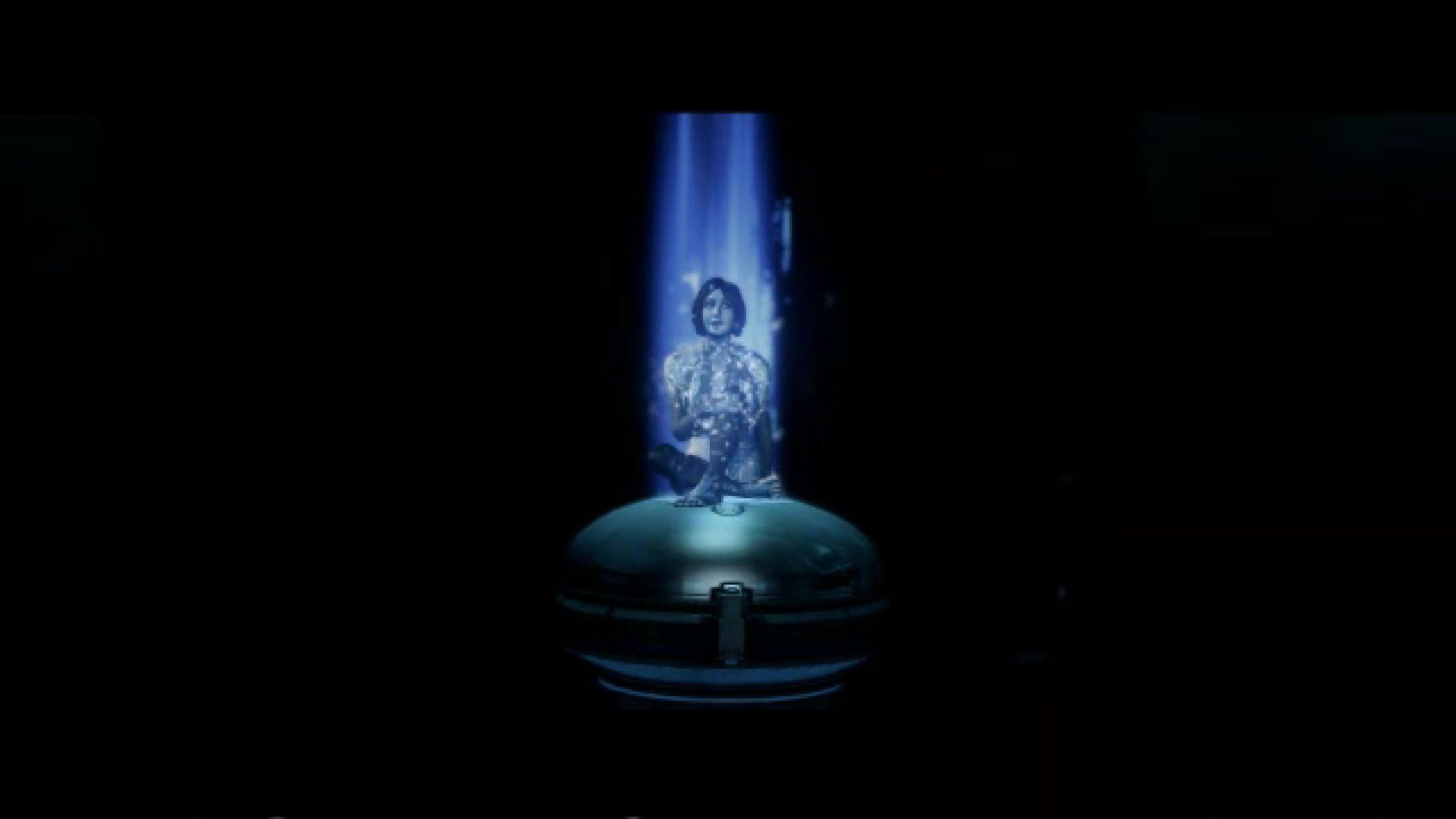


Master Chief and are those Spartan IV’s in the background?

Another Knight? This one looks different.

My NEW favorite vehicle. The UNSC Mammoth!!! (Just look how big it is with the Warthog in front of it.)

Cortana gone rampant???

Fin.

Moving onto screenshots from the campaign…
Our first shot shows the new HUD. Very clean looking and doesn’t interfere with the viewing area.

This next shot shows the HUD again, now with Cortana is the upper left corner.

Just look at this lush jungle!

Zoomed in. Note the truncated nose of the Jackal. Well it appears so anyway. And there are the new style grunts.
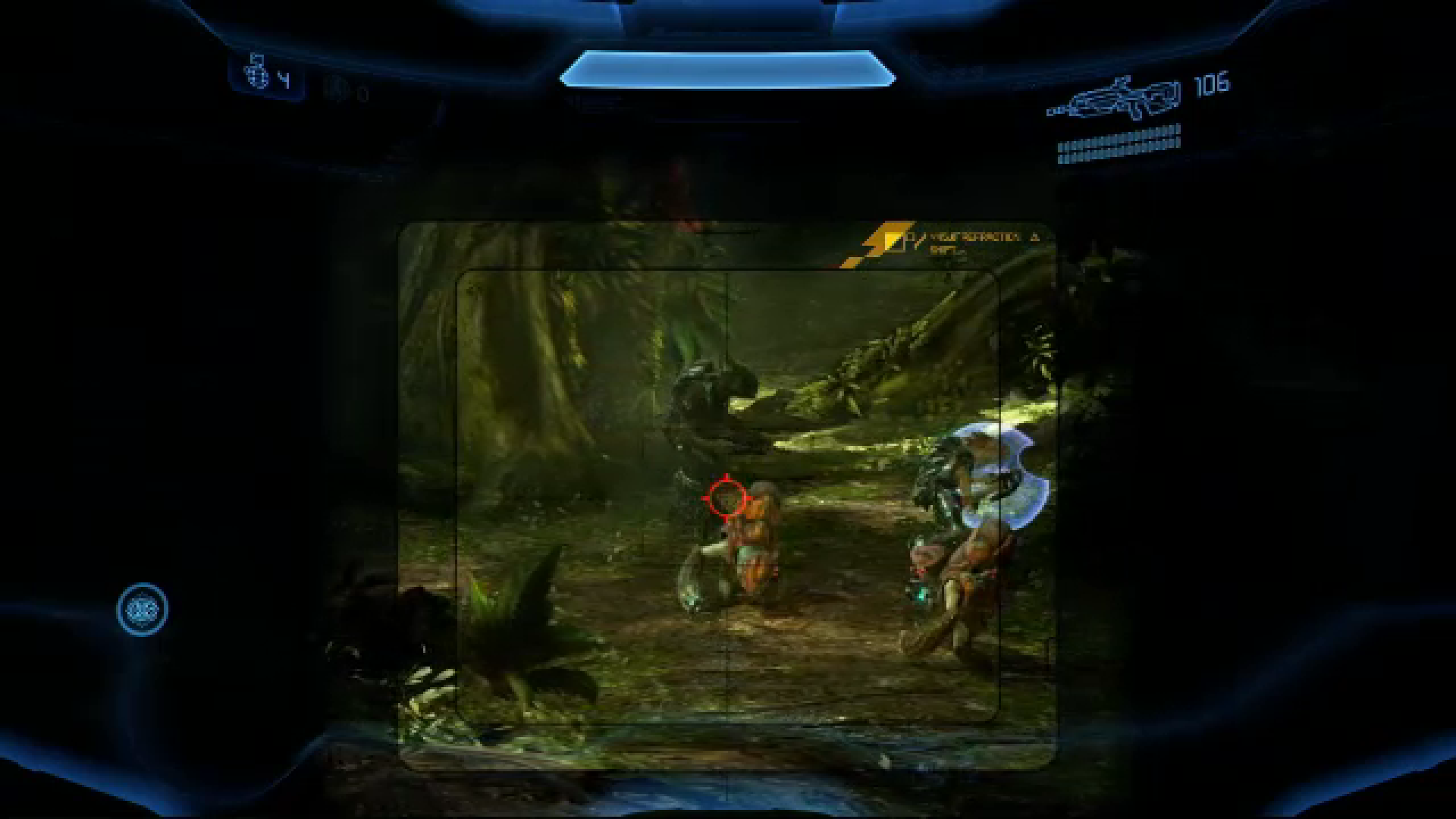
Shooting with the AR, note the splash on the visor, very cool touch.
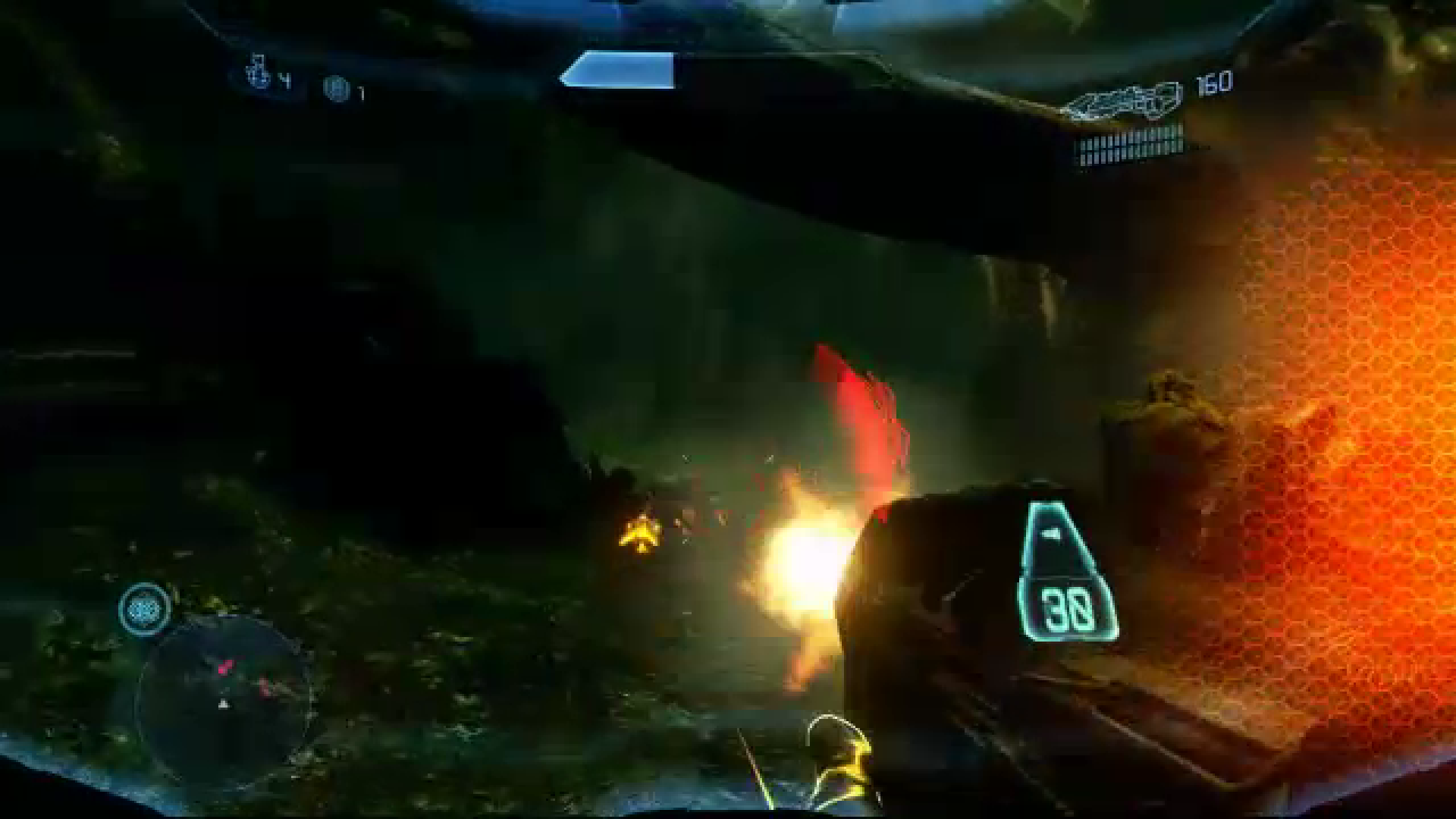
A Promethean Knight

OMG, it just ROWR’d at us! (Awesome)

The Pro/Knight uses a “Light Shield”

More disintegrations please!
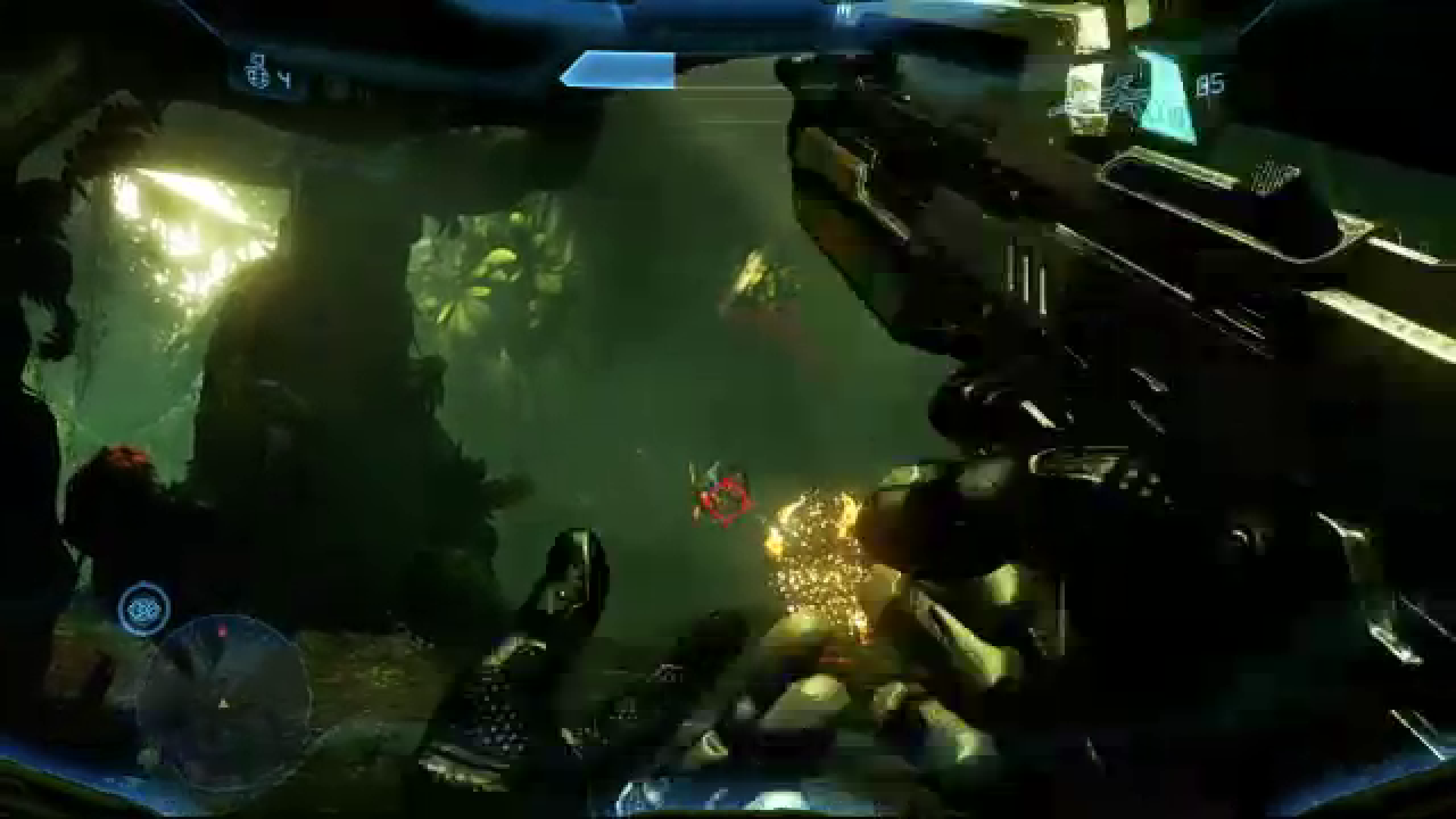
Wow, Forerunner weapons PHASE together when picked up!

Another Forerunner weapon, the Scattershot. It’s the Forerunner shotgun equivalent:

Hmm, it’s this the new VISR mode or Promethean vision?
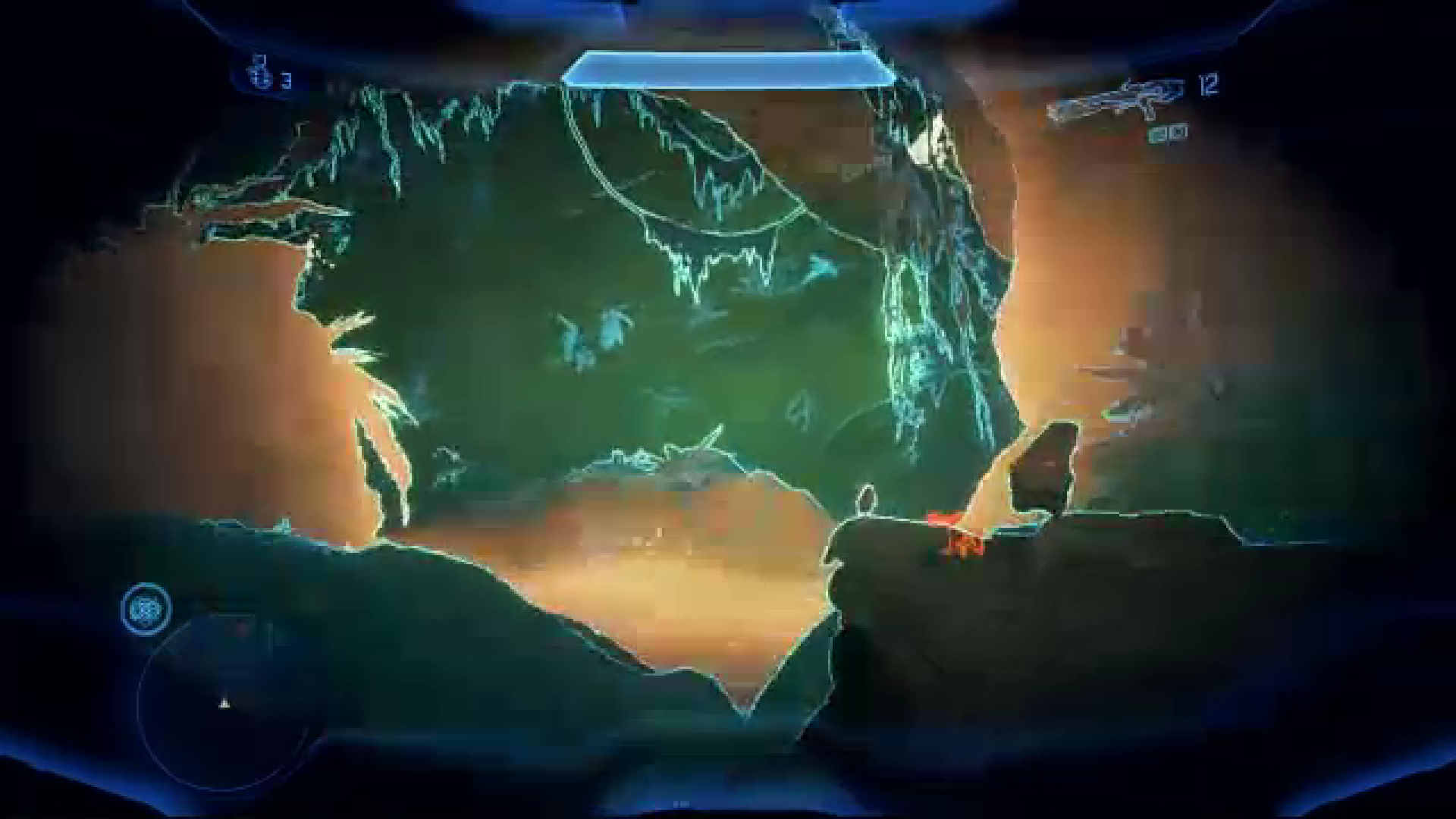
Yet more to come! LOTS MORE Halo 4 coverage today/tonight!!!
Wow, I”m trying to get caught up on all the Halo 4 goodness from today. In the meantime, here is video I shot of myself reacting to the trailer of Halo 4 from E3 2012.
Excuse my appearance. I had a horrible night’s sleep.
Wow, was the trailer amazing. The graphics look years ahead of anything else out there. The campaign looks simply amazing. New weapons, enemies, and just, wow!
Here are some of my favorite screenshots from the trailer (with some discussion regarding specific ones) (Oh and apologies for the quality of some of the shots. Hi-res hopefully soon to follow):
Here’s a shot from the live action portion of the trailer, though this is obviously CG.

The UNSC Infinity looks amazing. (But wait there is more of her later)
Look at the size of that thing!

Seriously, it’s gargantuan compared to the UNSC frigate to the left and those are not slouches in size.
As the UNSC Infinity gets sucked into the Forerunner shield world “Requiem,” some vehicles inside get tossed around. In the next two shots we see a new vehicle, the “Mammoth.”

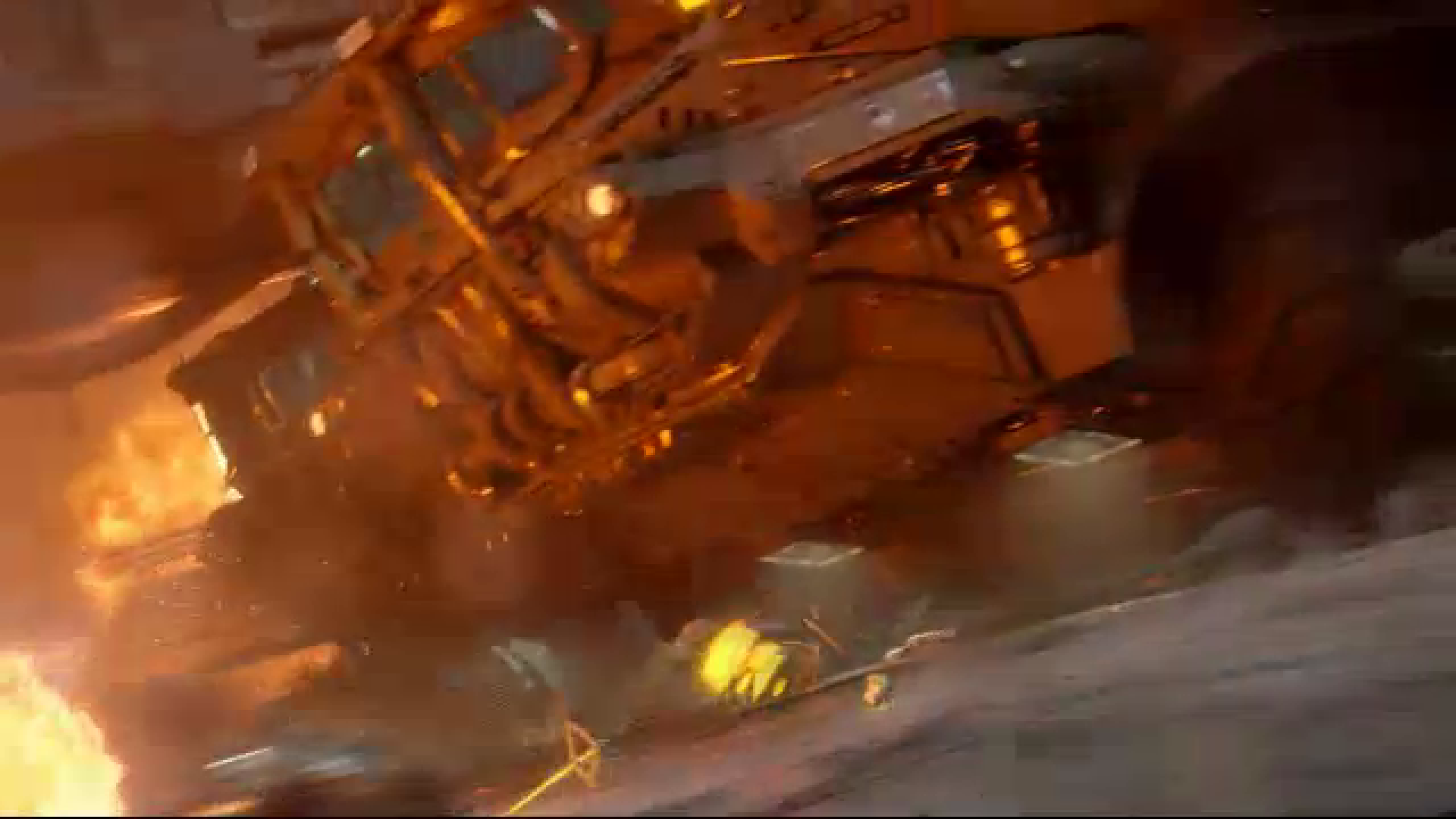
The UNSC Infinity getting sucked in:



The ship makes it’s final approaching crash landing on the planet:




Hmm, who is this figure at the bottom of the above shot???

It’s Master Chief of course!




Isn’t she a thing of Beauty? (Below)

Wait, Master Chief hears then sees something:

What could it be?
OMG?! A Forerunner Sphere!!

Next post: Campaign Gameplay!
Austin Rukari just posted on Twitter, a pic of Frank O’Conner at E3, preparing for the big Halo 4 reveal.
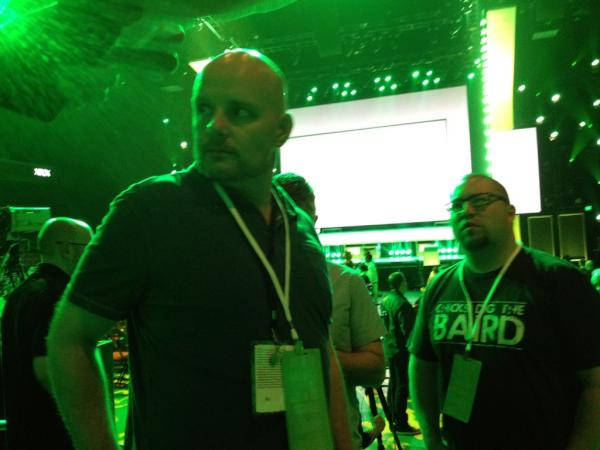
Lots and lots of GREEN.
Man, the excitement is just building up! Can you feel it?
This is a LONG article with NO TL:DR section. Though you may want to scroll to the “Summation” section at the bottom of the article.
The following “Fact” section was taken directly from the links provided after specific sections. I did not include all the text from those links, electing to copy that which I felt was pertinent and reasonably understood by all. Please check out the links for much more information on Lasers.
Discliamer: I am not a scientist, so I may get some things wrong in this article. Now onto the article:
Fact
What is a Laser?
A laser is a device that emits light (electromagnetic radiation) through a process of optical amplification based on the stimulated emission of photons. The term “laser” originated as an acronym for Light Amplification by Stimulated Emission of Radiation. The emitted laser light is notable for its high degree of spatial and temporal coherence, unattainable using other technologies. In modern usage “light” broadly denotes electromagnetic radiation of any frequency, not only visible light, hence infrared laser, ultraviolet laser, X-ray laser, and so on. (Layman’s terms: Light is bounced back and forth at an accelerated speed between mirrors-one being partially transparent, light escaping this can be focus to form a laser.)
Spatial coherence typically is expressed through the output being a narrow beam which is diffraction-limited, often a so-called “pencil beam.” Laser beams can be focused to very tiny spots, achieving a very high irradiance. Or they can be launched into a beam of very low divergence in order to concentrate their power at a large distance.
Temporal (or longitudinal) coherence implies a polarized wave at a single frequency whose phase is correlated over a relatively large distance (the coherence length) along the beam.
Most so-called “single wavelength” lasers actually produce radiation in several modes having slightly different frequencies (wavelengths), often not in a single polarization. And although temporal coherence implies monochromaticity, there are even lasers that emit a broad spectrum of light, or emit different wavelengths of light simultaneously. There are some lasers which are not single spatial mode and consequently their light beams diverge more than required by the diffraction limit. However all such devices are classified as “lasers” based on their method of producing that light: stimulated emission. Lasers are employed in applications where light of the required spatial or temporal coherence could not be produced using simpler technologies.
How is a laser created/designed?
A laser consists of a gain medium, a mechanism to supply energy to it, and something to provide optical feedback. The gain medium is a material with properties that allow it to amplify light by stimulated emission. Light of a specific wavelength that passes through the gain medium is amplified (increases in power).
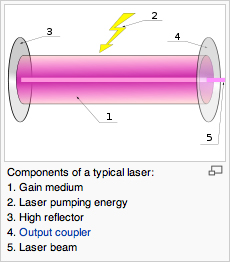
For the gain medium to amplify light, it needs to be supplied with energy. This process is called pumping. The energy is typically supplied as an electrical current, or as light at a different wavelength. Pump light may be provided by a flash lamp or by another laser.
The most common type of laser uses feedback from an optical cavity—a pair of mirrors on either end of the gain medium. Light bounces back and forth between the mirrors, passing through the gain medium and being amplified each time. Typically one of the two mirrors, the output coupler, is partially transparent. Some of the light escapes through this mirror. Depending on the design of the cavity (whether the mirrors are flat or curved), the light coming out of the laser may spread out or form a narrow beam. This type of device is sometimes called a laser oscillator in analogy to electronic oscillators, in which an electronic amplifier receives electrical feedback that causes it to produce a signal.
Most practical lasers contain additional elements that affect properties of the emitted light such as the polarization, the wavelength, and the shape of the beam.
The light emitted:
The beam in the cavity and the output beam of the laser, when travelling in free space (or a homogenous medium) rather than waveguides (as in an optical fiber laser), can be approximated as a Gaussian beam in most lasers; such beams exhibit the minimum divergence for a given diameter. (Think Gauss Hog’s laser).
The differences of a Red or Green laser are as such:
The red laser light has a longer wavelength (about 650 nanometers) than does the green (about 532 nanometers). The mechanism behind making them is also different. Red lasers use a diode, optics, and some electronics. These are fairly easy to make and assemble, so red lasers are cheap. The green laser, on the other hand, requires a special diode (an 808 diode for those who know their lasers), a second infrared laser crystal, and a frequency-doubling crystal. These have to be very carefully aligned in order for the laser to function properly.
For more info on the color of lasers please check out this link: http://www.physlink.com/education/askexperts/ae435.cfm
Pulse mode of operation:
Pulsed operation of lasers refers to any laser not classified as continuous wave, so that the optical power appears in pulses of some duration at some repetition rate. This encompasses a wide range of technologies addressing a number of different motivations. Some lasers are pulsed simply because they cannot be run in continuous mode.
In other cases the application requires the production of pulses having as large an energy as possible. Since the pulse energy is equal to the average power divided by the repetition rate, this goal can sometimes be satisfied by lowering the rate of pulses so that more energy can be built up in between pulses.
Other applications rely on the peak pulse power (rather than the energy in the pulse), especially in order to obtain nonlinear optical effects. For a given pulse energy, this requires creating pulses of the shortest possible duration utilizing techniques such as Q-switching.
In a Q-switched laser, the population inversion is allowed to build up by introducing loss inside the resonator which exceeds the gain of the medium; this can also be described as a reduction of the quality factor or ‘Q’ of the cavity. Then, after the pump energy stored in the laser medium has approached the maximum possible level, the introduced loss mechanism (often an electro- or acousto-optical element) is rapidly removed (or that occurs by itself in a passive device), allowing lasing to begin which rapidly obtains the stored energy in the gain medium. This results in a short pulse incorporating that energy, and thus a high peak power.
Pulsed pumping:
Another method of achieving pulsed laser operation is to pump the laser material with a source that is itself pulsed, either through electronic charging in the case of flash lamps, or another laser which is already pulsed. Pulsed pumping was historically used with dye lasers where the inverted population lifetime of a dye molecule was so short that a high energy, fast pump was needed. The way to overcome this problem was to charge up large capacitors which are then switched to discharge through flashlamps, producing an intense flash.
http://en.wikipedia.org/wiki/Laser
Gas Dynamic Laser:
Gas Dynamic Laser (GDL) is laser based on differences in relaxation velocities of molecular vibrational states. The laser medium gas has such properties that an energetically lower vibrational state relaxes faster than a higher vibrational state, thus a population inversion is achieved in a particular time.
Pure Gas dynamic lasers usually use a combustion chamber, supersonic expansion nozzle and CO2 as an active laser medium in mixture with nitrogen or helium. Gas dynamic laser could be however pumped not only by combustion, but by any adiabatic expansion of gas. Any hot and compressed gas with appropriate vibrational structure could be utilized.
Explosively pumped gas dynamic laser is a version of gas dynamic laser pumped by expansion of explosion products. Hexanitrobenzene and/or tetranitromethane with metal powder is preferred explosive. This device could have very high pulse peak power output applicable in laser weapons.
How a Gas Dynamic Laser Functions:
1. Hot compressed gas is generated.
2. Gas expands through subsonic or supersonic expansion nozzle, the temperature of the gas becomes lower and according to maxwell–Boltzmann distribution the gas isn’t in thermodynamic equilibrium until the vibrational states relax.
3. The gas flows through the tube of a particular length for a particular time. In this time lower vibrational state does relax but higher vibrational state doesn’t. Thus population inversion is achieved.
4. Gas flows through mirror area where stimulated emission takes place.
5. Gas returns to equilibrium and becomes warm. It must be removed from the laser cavity or it will interfere with the thermodynamics and vibrational state relaxation of the freshly expanded gas.
http://en.wikipedia.org/wiki/Gas_dynamic_laser
Operational Advantages of Lasers:
Laser weapons could have several main advantages over conventional weaponry:
Blooming of a Laser:
Laser beams begin to cause plasma breakdown in the air at energy densities of around a megajoule per cubic centimeter. This effect, called “blooming,” causes the laser to defocus and disperse energy into the atmosphere. Blooming can be more severe if there is fog, smoke, or dust in the air.
Reducing blooming:
High Power Consumption:
One major problem with laser weapons (and directed-energy weapons in general) is their high electric energy requirements. Existing methods of storing, conducting, transforming, and directing energy are inadequate to produce a convenient hand-held weapon. Existing lasers waste much energy as heat, requiring still-bulky cooling equipment to avoid overheating damage. Air cooling could yield an unacceptable delay between shots. These problems, which severely limit laser weapon practicality at present, might be offset by:
Weaponized lasers of the present:
Pulsed Energy Projectile or PEP systems emit an infrared laser pulse which creates rapidly expanding plasma at the target. The resulting sound, shock and electromagnetic waves stun the target and cause pain and temporary paralysis. The weapon is under development and is intended as a non-lethal weapon in crowd control.
• Made by Northrop Grumman:
• On 19 July 2010 an anti-aircraft laser described as the Laser Close-In Weapon System was unveiled at the Farnborough Airshow.
• The Mid-Infrared Advanced Chemical Laser (MIRACL) is an experimental U.S. Navy deuterium fluoride laser and was tested against an Air Force satellite in 1997.
• In 2011, the U.S. Navy began to test the Maritime Laser Demonstrator (MLD), a laser for use aboard its warships.
• Personnel Halting and Stimulation Response, or PHaSR, is a non-lethal hand-held weapon developed by the United States Air Force. Its purpose is to “dazzle” or stun a target. It was developed by Air Force’s Directed Energy Directorate.
• Tactical High Energy Laser (THEL) is a weaponized deuterium fluoride laser developed in a joint research project by Israel and the U.S. It is designed to shoot down aircraft and missiles. See also National missile defense.
• The U.S. Air Force’s Airborne Laser, or Advanced Tactical Laser, is a plan to mount a CO2 gas laser or COIL chemical laser on a modified Boeing 747 to shoot down missiles
http://en.wikipedia.org/wiki/Directed-energy_weapon
Fiction:
The Haloverse utilizes lasers to a varying degree. None is known better than the Spartan Laser, or Splaser as it is known to some. The Splaser is a portable shoulder mounted weapon with precision and high energy output. It is capable of killing anything up to the largest ground based vehicles in one shot. Though it may take a another shot for vehicles such as a Wraith of Scorpion. The Spartan Laser’s full name is the Weapon/Anti-Vehicle Model 6 Grindell/Galilean Nonlinear Rifle, (abbreviated W/AV M6 G/GNR).
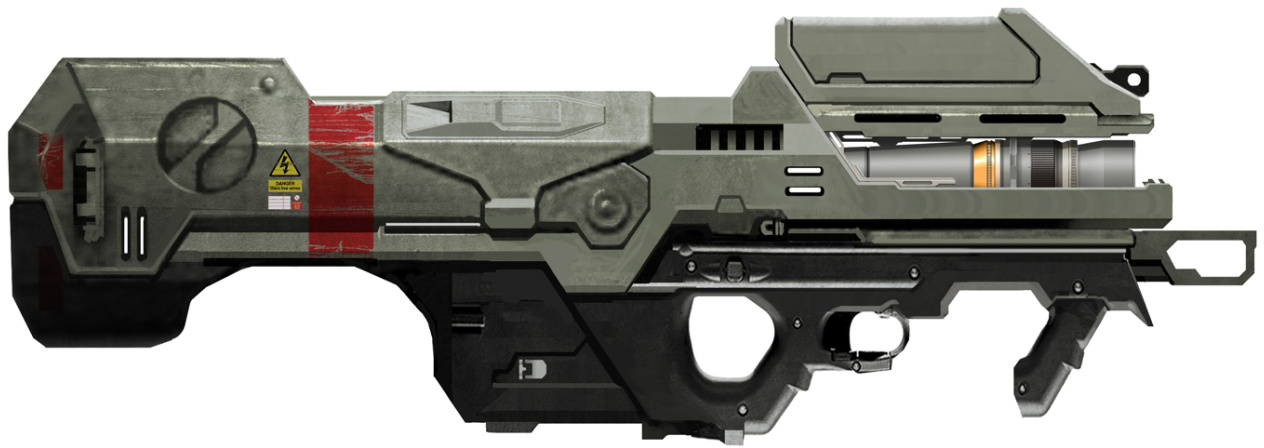
The Spartan Laser is powered by a BA-53635/PLMD non-replaceable battery. Even though the name of the weapons implies use by Spartans, it has been used by ODSTs and marines alike. The Splaser utilizes a laser scope to help the user direct their shot to the intended target. The splaser uses a charging system, similar to real-life pulse lasers. Once charged, the Splaser delivers a devastating directed laser many magnifications higher than is known and/or used presently. Unlike present day lasers, the Splaser makes use of an auditory function to let the user know of impending discharge of the weapon. The total charge time takes roughly 2.5 seconds.
The Splaser is not a one beam weapon. In fact it is several smaller beams shot quickly to give the appearance of one intense beam.
The Spartan Laser though powerful and deadly is limited by the amount of shots it can produce, due to the battery.
Summation:
It is clear given the information in the factual section that lasers not only exist (and have for some time now), but can also be weaponized. No doubt a laser of today has the same if not more destructive firepower of a Spartan Laser. However, these are huge and no where near ready to be utilized as a shoulder mounted weapon. Given the advances of science in the past century it is reasonably plausible that a weapon such as the Spartan Laser will exist by the time period of the Haloverse.
-Sal

Just release final product shots of the McFarlane Halo Avatar figure line have surfaced. Here they are in compilation shots for ease of viewing:





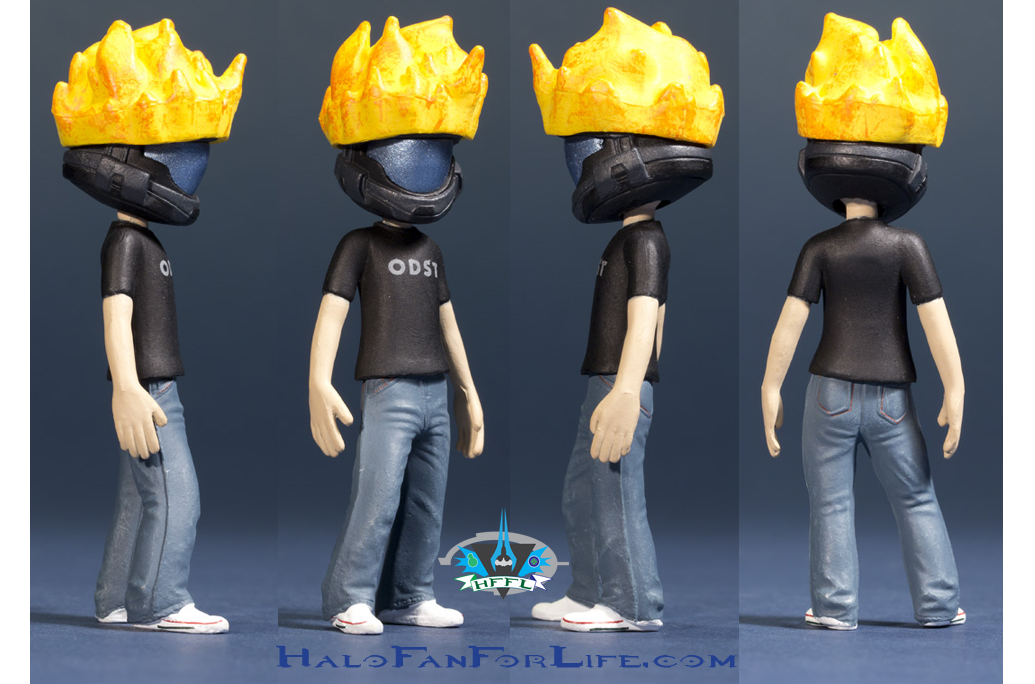


Each come prepackaging blindly one in a tube, seen at the bottom right of the following image:

These should retail for around $3-4 depending on where bought.
So that brings up the question. Where can you buy these? Well here you go my fine readers:
• Blockbuster Mexico
• Fred Meyer
• FYE
• GameStop
• HEB
• Kroger
• Target
• Toys ‘R’ Us
• Toys ‘R’ Us Canada
• Walmart Canada
Credit to Spawn.com for the original pics for which I photoshopped together.
-HFFL
